Gold
Sell a gold watch or pocket watch
Gold wristwatches and pocket watches are bought by post, and each is looked at as a watch first. Two questions come before the weight: is the case solid gold or a gold skin over brass, and is the watch worth more running than in pieces?
Send a photograph and a person looks at it. They tell you what the pieces are, what is plated rather than solid, and which ones are worth posting. Nothing is committed either way, and nobody chases you afterwards.
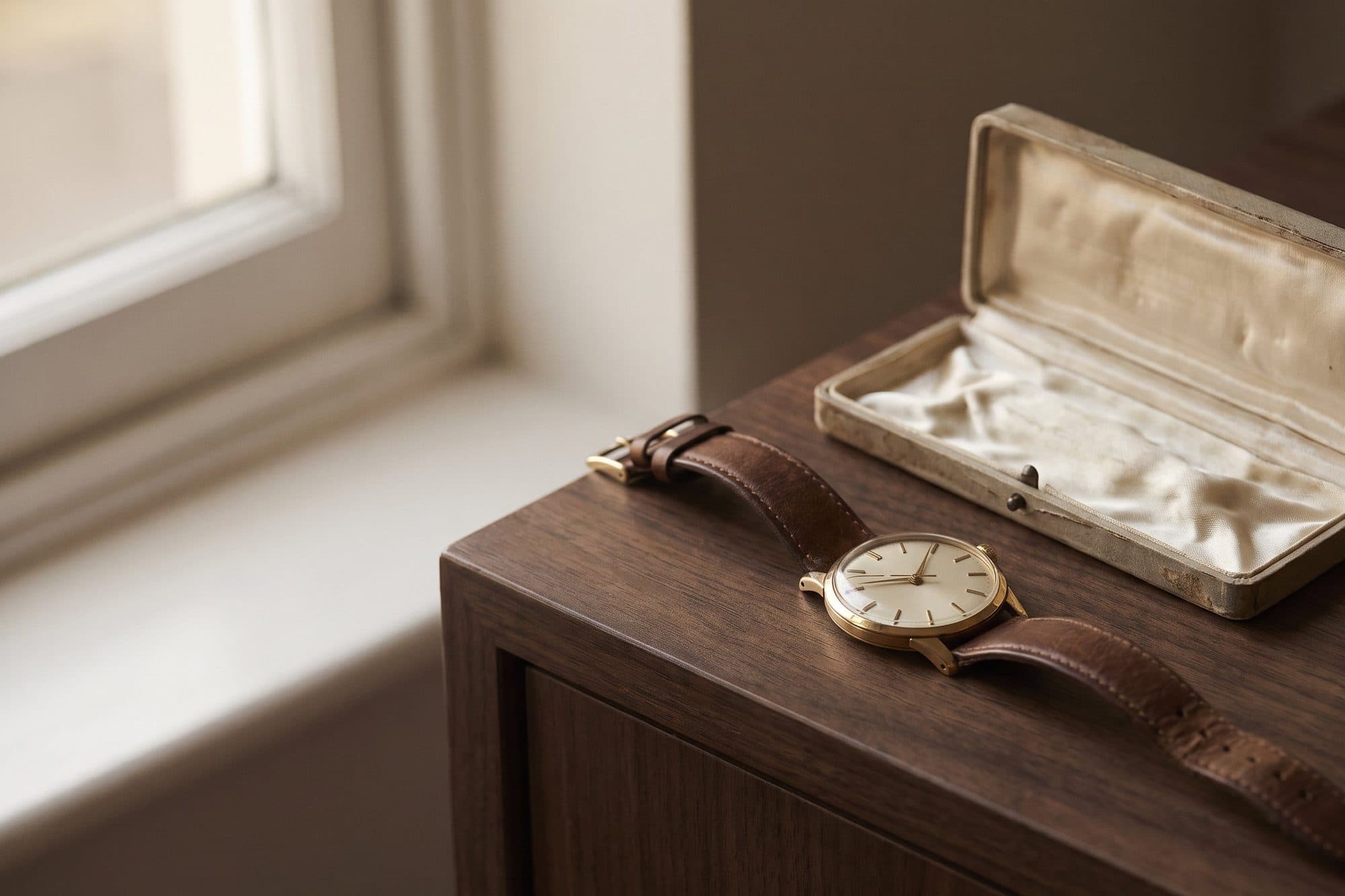
Illustration Computer-generated, not a customer’s lot.
- Where the marks areinside the case back, sometimes inside the front lid
- Solid gold marks375, 585, 750 or 916 with an assay office mark
- Not goldrolled gold, RG, GF, GP, plaqué, doublé, 1/20 12K GF
- Not metalmovement, glass, dial, hands, steel back
- Worth more wholea name on the dial, a movement that runs, box and papers
In short
Gold watches are bought by post and checked as watches first. A maker's name, a running movement or the original box and papers can put one well beyond what its case is worth, and you are told before anything is priced. Only a solid gold case and bracelet count as metal, and the movement stays in the case until you accept.
Before anything else: is this worth more as a watch?
Nothing is dismantled before you say yes
Some watches are worth several times what their case is worth as metal. A recognised maker, a movement that runs when wound, a chronograph or calendar, an early English pocket watch, or the original box and guarantee can each put a watch in that group. The case back is opened to read the marks inside it, and that is as far as anything goes: no watch is dismantled, and no movement leaves its case, before you have accepted an offer for it (clause 4.4). Such a watch is flagged, and it is priced as metal only if you confirm in writing that you want that.
What gets looked for is straightforward, and you can look for it yourself before you post anything.
- A name on the dial or engraved on the movement.
- A second hand that moves, or a balance wheel that swings when you tip the watch.
- A case back that unscrews rather than snapping shut, which usually means a better watch.
- Anything unusual about the dial, such as a calendar window, a second small dial, or an enamel face rather than a printed one.
None of that changes the gold. All of it can change what the watch is worth, and it only works one way. A watch kept whole can still go for its gold next month; a melted one cannot be put back together. If a specialist or an auction room is the better route, you are told, and the watch is posted back free whether or not you sell us anything else.
Reading the marks inside the case back
The marks are almost always inside the case back rather than outside, and on a hunter pocket watch there is often a second set inside the front lid. If you are not confident opening a watch, leave it shut and photograph the outside instead. A snap back prised with a kitchen knife scratches the case and sometimes bends the lip.
What a watch case mark tells you
| Mark | What it is | Solid gold? |
|---|---|---|
| 375, 585, 750 or 916 with an assay office mark, often beside a crown | A British hallmark for 9ct, 14ct, 18ct or 22ct | Yes |
| 9 .375, 12 .5, 14 .585 or 15 .625, or 18 or 22 beside a crown | Older British marks; 12ct and 15ct ended in 1932, when 14ct came in | Yes, at the standard shown |
| 0.585, 0.750, 18K or 14K with no assay office mark | A manufacturer's stamp, common on imported cases: a claim, not an assay | Usually, once tested |
| Rolled gold, RG, gold-filled, GF, 1/20 12K GF, plaqué, doublé | A gold layer bonded to base metal | No |
| Gold plated, GP, 10 microns, electroplated | Electroplated brass or nickel | No |
A solid gold watch case is thin sheet metal shaped into a shell, and once the movement is out of a small wristwatch there is often surprisingly little of it. People who judged the watch by its weight in the hand are frequently taken aback, because most of what they were feeling was steel. The UK hallmarks guide shows each mark at size.
Rolled gold, gold-filled and the watches that only look gold
The great majority of yellow twentieth-century watches are rolled gold or gold-filled. It is a real gold layer, thicker than plating and bonded rather than deposited, which is why these cases can look perfect after eighty years. There is still nowhere near enough of it to recover, so there is no metal in them for us to buy, and we would rather say that plainly than find a form of words.
- Look at the wear points: the edge of the case, the lugs where the strap sits, the raised bit above the winder. On a filled case these rub through to pink or grey.
- Look for a stamp that names the thickness, such as “20 microns” or “10 micron plated”. A solid case never states a thickness, because there is nothing to state.
- Look at the weight for the size. A gold-filled case is mostly brass and feels light for what it is.
- Hollow bracelet links give themselves away the same way: they look substantial and weigh almost nothing.
- A filled case that runs may still be worth more as a working watch than a solid gold case that does not. Not gold is not the same as not worth anything.
Surface testing can be fooled by a filled case, because the surface is gold, so the marks, the weight for size and a magnet come first. Then, where an analyser is available, a reading is taken inside the case back, where any layer is thinnest. An acid touchstone test is used only if you have agreed to it in writing (clause 4.2). Plated, rolled gold, gold-filled and vermeil sets the four constructions side by side.
The parts of a watch that are not bought as metal
- The movement. Steel and brass, with jewels that are synthetic ruby. On a small wristwatch it can be a third of the whole weight. Its weight is estimated and left out, it stays in the case until you have accepted, and it is then returned to you on request.
- The glass, dial and hands. Dials are usually silvered brass or enamel fired onto copper. They go back with the movement.
- Steel case parts. A stainless back screwed onto a gold-fronted case is very common, and the two are told apart before anything is decided.
- The bracelet. Bought only where it tests as solid gold, and treated as a separate item from the case, because the two are frequently different metals.
- Leather, fabric and rubber straps. Take them off if it is easy; leave them on if it is not.
Movements are not rubbish, which is why they are offered back rather than binned. Repairers buy them for parts, and a watch that was flagged as possibly worth more whole is never separated from its movement at all. No movement leaves its case before you have accepted an offer. If you want the movement back, say so when you send the parcel and it is noted on your list from the start.
Send the whole watch box
Watch boxes are where the odd things collect: a broken wristwatch, a pocket watch with no glass, two Albert chains, a fob, a handful of spare links, a strap buckle, a watch key. The chains and links are often the solid gold in the box while the watch everybody assumed was gold turns out to be filled. Send it all and let it be sorted out here; scrap gold jewellery covers the chains.
Pack watches so glass cannot break against metal. A wristwatch wrapped on its own in a piece of kitchen paper, inside a small bag, is enough. If a pocket watch has a loose bezel or a cracked crystal, wrap it and say so rather than trying to mend it, because broken glass scratches everything else in the parcel. Security and insurance covers the rest of the packing and the cover.
For anything with a name you recognise, the first step is not posting at all. Photograph the dial, the case back inside and out, and the movement if the back is already open, then send the pictures on WhatsApp. That costs nothing and answers the question that matters. If this came to you with a house or an estate, inherited jewellery and house clearance gold and silver cover sending a mixed lot in one go.
What happens to a watch when it arrives
- Recorded as it arrivedEvery watch is photographed whole, with its strap, box and papers if they came with it, before anything is opened.
- Assessed as a watchDial, movement, case style and condition are looked at, and it is wound to see whether it runs. Anything that should not be scrapped is set aside here and you are told.
- Case marks readThe back is opened by someone with the right tools so that the marks inside it can be read under magnification and photographed, and the case is tested where those marks are absent or ambiguous. Nothing comes out of the case, and the back goes back on.
- Case and bracelet treated separatelyEach is identified on its own, because a solid case on a plated bracelet is the usual arrangement and occasionally it is the other way round.
- Listed, then one offerYou see what arrived, what it is, and what is being bought. Nothing is taken apart until you have accepted; offers, returns and payment sets out each answer you can give.
The one thing that never happens is a watch going straight onto a balance. Weight is the last question about a watch, not the first, and starting there would skip the part where your grandfather's chronograph gets recognised as a chronograph. How it works covers the stages around this one.
What we buy, and what we leave out
We buy
- Solid gold wristwatch cases, 9ct to 22ct, running or not
- Solid gold pocket watch cases: open-face, half-hunter and full-hunter, including dented ones
- Solid gold watch bracelets, buckles and clasps that test as gold
- Gold watch chains, Alberts, fobs, seals and watch keys
- Loose spare links, lugs and case parts
- Whole watch boxes, sent as they are
We do not buy
- Gold-plated, gold-filled, rolled-gold and gold-capped cases and bracelets
- Steel, titanium and base-metal cases
- Movements, dials, glasses and hands, which stay in the case until you accept and are returned on request
- Any watch whose case cannot be opened without damaging something worth keeping, until we have asked you and you have said to go on
- Leather and fabric straps
Stopped before anything is treated as scrap
- Any watch with a recognised maker's name on the dial or movement is flagged before anything is decided
- A watch that runs and keeps reasonable time is usually worth more intact, whether the case is solid or filled
- Pocket watches with complications, enamel dials, engraved cases or early English movements attract specialist interest
- A watch with its original box, guarantee and receipts is worth materially more as a set than on its own
- Movements with value to repairers are offered back after you accept rather than discarded
- Military, railway and presentation watches with an inscription are checked for provenance before anything else
Questions sellers ask
How do I tell whether my watch case is solid gold or plated?
If the back opens safely, look inside it for 375, 585, 750 or 916 with an assay office mark beside it, often with a crown. That settles it. Rolled gold, gold-filled, GF, GP, plaqué or doublé mean a layer over base metal. If there are no marks at all, photograph the case back and we will read what is there.
Do you buy the watch movement?
No, it is steel and brass rather than precious metal, but you do not lose it. It stays in the case until you accept an offer, then it is returned on request with the dial and hands. Some movements are worth something to repairers.
My watch has a well-known name on the dial. Should I send it for scrap?
Not until it has been looked at as a watch. It would be flagged here and you would be told to get a specialist opinion first. If you still prefer the metal route afterwards, that is your decision to make with the information in front of you.
What is a 15ct or 12ct watch case?
Older British standards, used until 1932 when 14ct replaced them. A 15ct case is 625 parts per thousand and a 12ct case is 500. Both are perfectly real gold at the standard they state.
Is the bracelet counted with the case?
No, they are identified separately, because they are so often different. A solid gold case on a plated or hollow bracelet is the usual arrangement, and treating them as one thing would get one of them wrong.
The watch does not run. Does that matter?
For the metal, not at all. For the watch, sometimes: a good watch that has simply stopped is often worth servicing rather than scrapping, and that is part of what gets checked before anything is taken apart.
Sources
Related
- How it works
- Send photos first
- Request your postal pack
- What we buy
- Scrap gold jewellery
- Inherited jewellery
- House clearance
- Testing and XRF
- Security and insurance
- Offers, returns and payment
- Sell gold
- Gold plated, rolled gold, gold-filled and vermeil compared
- Reading UK hallmarks on gold, silver, platinum and palladium
- What to keep back: the pieces worth having looked at properly first
Not sure what you have? Start with photographs.
Photograph the lot: the tangled chains, the single earrings, the canteen nobody uses, the bits you cannot identify. Send it over and you get a rough idea back, with no pressure of any kind. Post it afterwards if you want to, or do not.
Nothing is sold until you say yes. Decline and it all comes back by tracked post, free; ask for part of it back and a fresh offer is made for the rest.
If a piece is worth more than its metal
A signed brooch, a date-run sovereign, a watch that still runs, a piece of early silver: anything that looks worth more whole is flagged to you before it is treated as metal, and you can take it back at that point.