Materials and items
What we buy, and what we send back
If it is gold, silver, platinum or palladium, we buy it by post: whole or broken, marked or unmarked, one piece or a whole drawer. What is not bought comes back to you, listed and unaltered, at our cost.
No obligation. Decline and it all comes back free; ask for part of it back and a fresh offer is made for the rest.
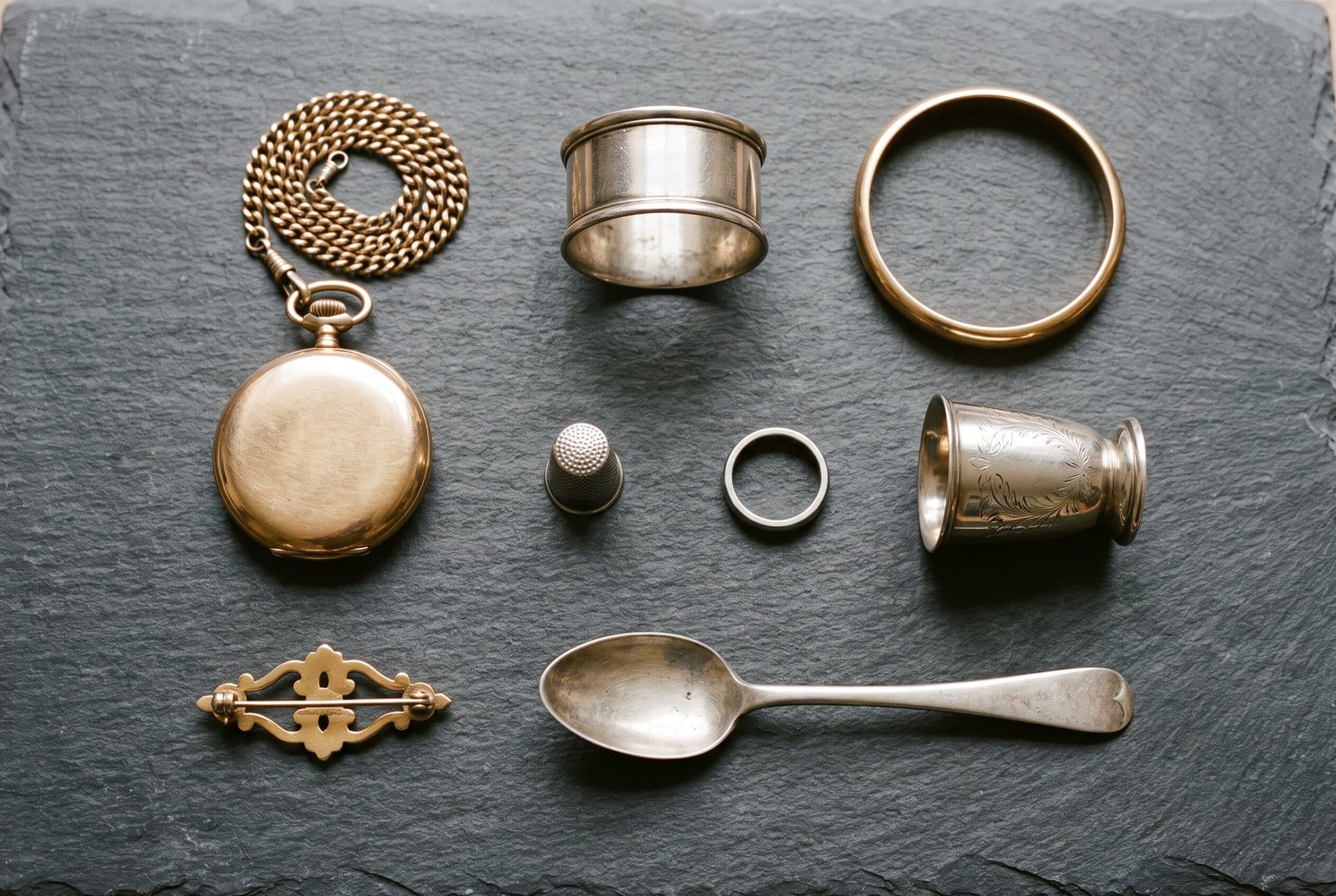
Illustration Computer-generated, not a customer’s lot.
In short
Assaypost buys gold at any carat, sterling, Britannia and continental silver, platinum and palladium, by post, whole or broken, marked or unmarked. Silver plate, costume jewellery, loose stones and base metal are not bought. Anything that arrives and is not bought is listed with the rest and posted back with whatever you decline.
Part I · 5 entries
Gold
Jewellery at any carat, coins, bars, dental work and gold-cased watches. Each page below says what the item looks like, what it is confused with and what happens to it here.
- Scrap and broken gold jewellery
The tangle at the back of the drawer is the gold most people own. Send all of it; working out what is what is our job.
- Gold coins and sovereigns
A sovereign in a drawer looks like every other sovereign. The date, the tiny letter and the condition are what separate them.
- Gold bars and bullion
A bar is the easiest thing in this catalogue to identify and the easiest to fake. Both facts are dealt with the same way: measurement.
- Dental gold
Two crowns that look identical can be completely different alloys. Nobody can judge these by eye, and nobody should try.
- Gold watches and pocket watches
Most yellow watches are not solid gold, and some of the ones that are should never be taken apart. Both questions get answered first.
Part II · 3 entries
Silver
Sterling, Britannia and continental silver: cutlery, tea sets, trays, coins and bars. Plate looks the same and is not silver.
- Silver cutlery and flatware
Most canteens brought out of a loft turn out to be plate. Finding out which yours is takes one mark and two minutes.
- Silver tea sets and hollowware
Turn everything upside down. The underside of a tea set tells you more in ten seconds than the top of it tells you in an hour.
- Silver coins and silver bars
Two identical-looking shillings can be sterling or nothing at all. The only thing that separates them is the date.
Part III · 1 entry
White metals
A white ring is the item most often mistaken for something else, and the three candidates are indistinguishable by eye. How anything here is tested is the same whichever material it turns out to be.
What is not bought, and what comes back anyway
Sending something on either list is not a mistake and costs you nothing. It is an easy thing to do, because from across a kitchen table it looks exactly like the things we do buy. It is identified, named on your list with the reason, and posted back with anything else you decline (clause 11.1 of the terms).
Not bought
- Gold-plated, rolled gold and gold-filled pieces. Marked GP, GEP, HGE, RGP, GF or 1/20 12K, or not marked at all. The gold on them is real and there is nowhere near enough of it to recover.
- Silver plate. EPNS, EP, A1, EPBM, Sheffield plate and nickel silver. The silver layer is microns thick and cannot be recovered.
- Costume jewellery and base-metal findings. Including the clasps, chains and settings that were fitted to real pieces at some point in their lives.
- Loose stones on their own. Stones set in jewellery are left out of the weight, and returned after you accept if you agree in writing to their removal; stones arriving without any metal are sent straight back.
- Steel, chrome, pewter and Britannia metal — a pewter alloy, nothing to do with Britannia silver. Cutlery blades, base-metal denture frameworks, and tankards and trophies that turn out not to be silver.
- Amalgam fillings. They contain mercury, they are clinical waste rather than scrap, and they have to go back through a dentist.
Comes back to you
- Stones. Left in their settings until you have accepted an offer and agreed in writing to their removal, then lifted where that can be done without damaging the setting and posted back. Where lifting would break a claw, the piece is described and left alone.
- Watch movements, dials, hands and glasses. Returned on request once you have accepted an offer, since nothing leaves a case before then, and never separated from a watch that has been flagged as worth more running.
- Handles, insulators and liners. Wooden teapot handles, bone and ivory insulators, glass liners out of sugar bowls and salt cellars. Nothing is taken off a piece before you accept, and a piece with ivory in it comes back whole.
- Coins with no silver in them. British coins dated 1947 onwards, and the cupro-nickel commemorative crowns sold in presentation packs.
- Boxes and cases. Canteen boxes, ring boxes, presentation cases and coin folders. Not bought, not thrown away.
- Anything worth more than its metal. A signed brooch, a scarce date, a working watch, a complete service by a recorded maker. Flagged and explained in writing before anything is priced, and posted back free if you would rather sell it elsewhere.
Send the lot, not the piece you are sure about
Mixed parcels are the normal case rather than the awkward one. A jewellery box, a canteen, a jar of old change and a tobacco tin of odds can all travel together and be dealt with as one lot, with one written offer at the end of it. Sorting them out is the work, and doing it once across everything is faster than doing it three times. How it works follows a lot from the first photograph to payment.
The pieces people leave at home are the ones they were unsure about, and those are exactly the ones worth sending. Send the whole group and let the identifying happen here. If this came from a house you are clearing or an estate you are dealing with, house clearance gold and silver, probate and estate jewellery and inherited jewellery set out how a mixed lot is handled from the first photograph onwards.
Items we hold rather than buy
An item is held rather than bought only where there are reasonable grounds to suspect it is stolen, and you are told in writing what is held and why; the procedure is on responsible sourcing. Where ownership simply cannot be established, the item is not bought and comes back to you. Ivory is different again: a piece with an ivory handle or insulator is not bought and not kept, so send photographs of it rather than posting it, and if one arrives anyway it comes back to you whole. The ivory guide and the identity guide explain both.
If you cannot name half of it
Almost nobody does, which is the reason to send photographs before you send anything else. Tip the box onto a plain cloth, take a few pictures, and a person will tell you what the marks suggest, what is likely to matter and whether anything ought to go to a specialist rather than to us.
Not sure what you have? Start with photographs.
Photograph the lot: the tangled chains, the single earrings, the canteen nobody uses, the bits you cannot identify. Send it over and you get a rough idea back, with no pressure of any kind. Post it afterwards if you want to, or do not.
Nothing is sold until you say yes. Decline and it all comes back by tracked post, free; ask for part of it back and a fresh offer is made for the rest.
If a piece is worth more than its metal
A signed brooch, a date-run sovereign, a watch that still runs, a piece of early silver: anything that looks worth more whole is flagged to you before it is treated as metal, and you can take it back at that point.