House clearance
House clearance: the gold and silver to pull out before the skip
Most of what looks like silver in a house is plate, and the gold is rarely in the jewellery box. Here is the sort. Photographs on WhatsApp tell you whether a bag is worth posting before you pack it.
No obligation. Decline and it all comes back free; ask for part of it back and a fresh offer is made for the rest.
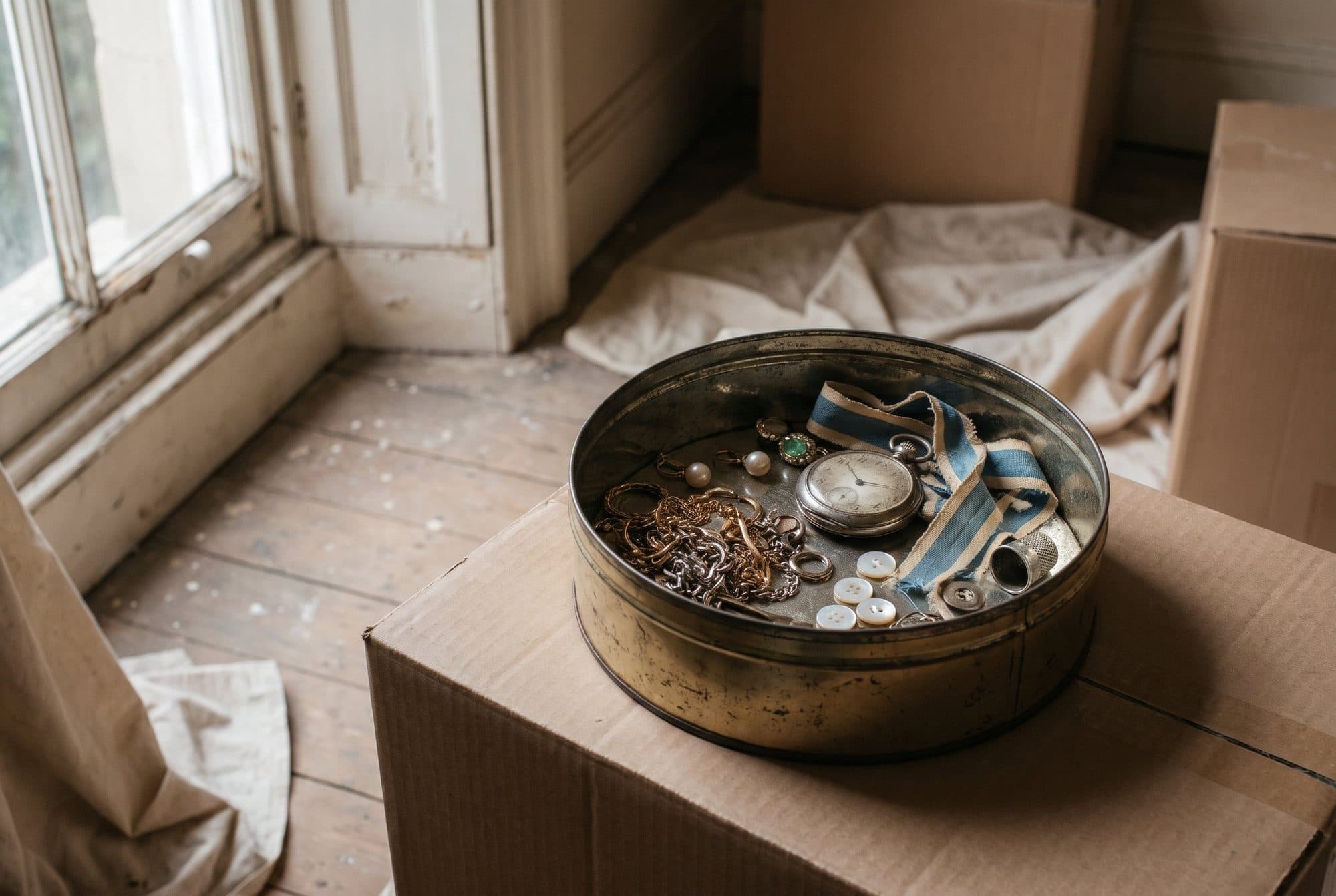
Illustration Computer-generated, not a customer’s lot.
In short
A house clearance usually produces one mixed bag: broken chain, odd earrings, a canteen that may be plate, a few coins and things nobody can name. Pull those out, then send them without sorting further. Every piece is numbered, weighed and tested on its own, so plate and sterling are separated at the bench rather than in the hallway. One written offer is made for the whole lot.
The sort
Two piles, done in the room. Anything you are unsure about goes in the first, because an unidentified thing costs nothing to send and a great deal to throw away.
Pull it out
- Anything stamped 375, 585, 750, 800, 916, 925, 950, 958 or 999.
- Anything that feels heavier in the hand than its size suggests.
- Cutlery with a small walking lion on it, and any canteen still in its box.
- Coins of any kind, above all small gold ones with a horse and rider on the back. Do not clean them.
- Watch cases, pocket and wrist, running or not.
- Broken chain, single earrings, clasps, jump rings and the debris at the bottom of a jewellery box.
- Dental gold, in whatever it is wrapped in.
- Thimbles, napkin rings, vesta cases, cigarette cases, christening mugs, small photograph frames.
- Medals and badges, uncleaned and on their ribbons: a named medal group should never be sold as scrap.
- Anything you cannot identify at all. That is what the sorting is for.
Leave it
- Anything marked EPNS, A1, EP, silver on copper or silver plate. Plate is not bought.
- Watch cases marked GF, RG, rolled gold or a fraction such as 1/20 12ct.
- Stainless steel cutlery with no hallmark on the handle. A silver-handled knife has a steel blade, so read the handle, not the blade.
- Costume jewellery. If it carries a designer's name, keep it for a different sale.
- Brass, copper, pewter and chrome, including the candlesticks that turn out to be one of them.
- Gilt that has worn through to a grey or yellow base on the high points.
- Anything a fridge magnet grips all over. A pull only at a clasp or a pin is normal.
- Cutlery with no mark at all, which is almost always plate or steel.
- Anything that might be ivory: a knife handle, a carved brooch, the insulators on a teapot. Photograph it and do not post it; the ivory guide explains why.
The right-hand column is where the disappointment lives. A canteen of EPNS in a fitted oak box looks exactly like the thing everyone hopes to find, and its silver is a skin a few microns thick that cannot be recovered. Silver plate, EPNS, A1 and Sheffield plate shows how to spot it before you carry the box down two flights of stairs.
If a whole jewellery box turns up, a box of jewellery you cannot identify sorts it into six piles. What to have looked at before you sell names the four kinds of object to set aside before anyone treats them as metal.
Where it actually is
In a house being cleared, the gold and silver is rarely all in the jewellery box. These are the places worth checking before anything goes in a skip.
- The bedside drawerLoose teeth wrapped in tissue, in a matchbox or a 35mm film pot. Dental gold looks like rubbish, which is exactly how it ends up in a bin bag.
- The button tinSnapped chain, one stud earring, a bent ring, a St Christopher with the loop gone. Nobody keeps a button tin because of the buttons.
- The bathroom cabinetA wedding ring in a tooth mug, worn thin and slipped off for the last time. Also spectacle frames, which are usually rolled gold rather than solid, but are worth a look.
- The garage and the shedCigarette cases, hip flasks, trophies and christening cups, black with tarnish and assumed to be junk. Tarnish is what silver does; it is not a verdict.
- The sewing boxThimbles, needle cases, stiletto and bodkin sets. Small, silver more often than not, and invisible in a bin bag.
- The loft and the top of the wardrobeA canteen in its fitted box, a tea service in a carrier bag, a christening set nobody used. Keep a set together; complete, it is a different thing from its parts.
- The bureau and the writing deskMedals, a sovereign in a coin purse, a signet in an envelope, cufflinks in a matchbox. Paperwork drawers are where small valuable things go to be forgotten.
Two checks you can do standing up
Neither settles anything. Both are fast, and between them they sort a bag well enough to decide whether it is worth posting.
- Get light on the markA phone camera held close, with the light from the side, reads a hallmark better than most eyes. You are looking for a three-figure number and a punched symbol beside it. Letters spelling something, such as EPNS, A1 or GF, mean the opposite of a hallmark.
- Put a magnet on itA fridge magnet is enough. Gold and silver are not magnetic, so a firm pull means steel somewhere. That alone proves nothing: clasps, watch backs, pins and knife blades are steel on otherwise good pieces, which is why their weight is left out.
What settles it is a weight and a test on the bench. Testing and XRF sets out what each method can and cannot establish, including why a surface reading on a plated item is not the last word.
Sending a mixed lot
- Photograph the pileBefore it goes in a bag, on a plain surface, in daylight. It takes a minute and gets you a useful answer on whether the lot is worth posting. If anything is ever in question, your photograph counts as evidence beside ours (clause 8.5).
- One bag to a propertyNever two houses in one bag. Label each bag and send one property's lot together. A second parcel on a later day is a separate lot with its own offer, unless you ask us in writing to hold the first (clause 3.3).
- Leave the unsure inDo not throw away the things you cannot identify to tidy the parcel. The parcel does not need to arrive sorted; it needs to arrive complete.
- Say roughly what you are sendingA clearance lot is usually heavier than a jewellery parcel, so give a rough weight and a rough idea of the contents when you ask for the label (clause 7.4). The service and its cover level are confirmed to you in writing before anything is posted.
- Pack it so it does not moveSmall items in a sealed bag inside the box, not loose; nothing rattling; nothing on the outside that says what is inside. Posting gold and silver safely has the packing detail.
- Keep the receiptHand it over at a Post Office counter and keep the receipt with its tracking number; it speeds a trace. The risk in the post is ours, and so is any claim, so losing the receipt costs you nothing (clause 7.3). See security and cover.
What happens when the bag is tipped out
The parcel is matched to your reference and photographed unopened before anyone cuts it (clause 8.1). If the packaging looks tampered with, or the contents are not what you told us, everything stops and you are told first (clauses 8.2 and 8.3).
- Everything is sorted into groups: gold from silver, marked from unmarked, solid from plated, metal from what is not. Nothing is taken apart, cleaned or polished to do it (clause 4.4).
- Each item is numbered and described, and keeps that number through weighing, testing, the offer and either the payment or the journey home.
- Weight that is not precious metal is estimated and left out while it is still attached: blades, springs, watch movements, stones, resin, cork, the loading in a candlestick.
- Anything that may be worth more whole than as metal is pulled out and flagged before any figure is put against it.
How it works follows a parcel the whole way through, and what we buy lists the items with the exclusions against each.
What you get back, in order
Seven undertakings. For a clearer the first and the fifth do most of the work: one saves the carriage on a bag of plate, the other means a wrong guess costs nothing.
- Ask before you postPhotographs from the doorstep, an answer from a person, no obligation. For a lot that might be all plate, this is the step that saves you the afternoon.
- Everything is itemisedEvery piece listed as it comes out of the bag, including the parts worth nothing. A bag does not become a heap; it becomes a list.
- One written offer for the lotOne amount for the whole lot, in writing, with every item on it. No haggling on a doorstep and no figure read out over a phone.
- Nothing is sold until you say yesYou accept by the button on the offer or in writing, and nothing lapses into a sale (clause 6.2). That matters most when you are clearing on somebody else's instructions.
- Free tracked returnDecline the lot and it comes back tracked and signed for, at our cost, including the parts that turned out to be plate (clause 6.3).
- Worth more whole? We say soThe medal, the signed brooch, the sovereign with a scarce date, the canteen worth more as a canteen: pulled out and named before anything is priced as metal.
- A person handles itAssaypost is one person, so whoever handled your last lot handles the next, and by the third you are not explaining from scratch how you bag things.
If you clear houses every week
There is no account to open and no scheme to join. What makes a repeated arrangement work is duller than that.
- One reference to a propertyAsk for a reference per house rather than per week. Two clearances on one reference produce one list, and a list that mixes two properties is no use to whoever is accounting for either.
- Authority settled onceIf you clear for a client, a landlord or an estate, we need the owner's written authority and the owner's identity as well as yours (clause 9.3). Settle it properly at the start rather than at every parcel; see responsible sourcing and AML.
- Know which pages to hand overWhen a family asks what you did with the contents, the page for executors and offers, returns and payment answer it better than you will at the door. If the clearance follows a death, inherited jewellery is the page for the family and selling jewellery before probate is granted the one for the executor. Dividing jewellery between beneficiaries helps when the family has not agreed who has what.
Worth reading alongside: silver cutlery and flatware for canteens and patterns, and weighted and loaded silver for why a heavy candlestick is mostly not silver. Where a clearance turns up a tin of coins, the tax position on inherited gold and coins is the page for whoever inherits them.
Questions clearers ask
Most of my bag is probably plate. Is it worth sending at all?
Send photographs first and you will be told, before anything is packed, whether there is enough in it to bother posting. A clearance lot is the kind of parcel where a person can tell a great deal from six photographs, and it saves you an afternoon if the answer is no.
What happens to the parts that are worth nothing?
They are listed as not bought, with a word on why (plated, base metal, nothing recoverable), left out of the offer and sent back to you with anything else you decline (clause 11.1). Nothing is thrown away on your behalf and nothing is quietly kept.
A clearance bag is heavy. Is there a weight limit?
Give a rough weight when you ask for the label and the service is chosen to suit it, or the lot is split across more than one parcel. If it is split, ask in writing for the parcels to be treated as one lot (clause 3.3). Posting gold and silver safely covers packing a heavy mixed lot.
Is it safe to post a bag like this?
Before you post anything to any buyer, how to check a postal gold buyer lists what to look up. On our label the risk in the post is ours in both directions (clause 7.2). If a parcel is lost, what is owed is what the items were worth, not a carrier's limit (clause 12.2).
Do you want the costume jewellery as well?
No. Costume jewellery is not precious metal and it is not bought here. It is worth separating rather than binning: a signed piece by a known costume house has its own market, and good gold chain has a habit of hiding in a tangle of gilt beads.
Should I clean it up first?
No, and this is the one instruction worth following exactly. Polishing takes metal and value off old silver, dips strip the darkening that gives a piece its age, and forcing a knotted chain apart snaps it. Tarnish, dust and tangles cost you nothing; a wire brush costs you the piece. Cleaning and polishing before you sell explains why.
Not sure what you have? Start with photographs.
Photograph the lot: the tangled chains, the single earrings, the canteen nobody uses, the bits you cannot identify. Send it over and you get a rough idea back, with no pressure of any kind. Post it afterwards if you want to, or do not.
Nothing is sold until you say yes. Decline and it all comes back by tracked post, free; ask for part of it back and a fresh offer is made for the rest.
If a piece is worth more than its metal
A signed brooch, a date-run sovereign, a watch that still runs, a piece of early silver: anything that looks worth more whole is flagged to you before it is treated as metal, and you can take it back at that point.