Gold
Sell gold by post, starting with a photograph
Assaypost buys gold from anyone in the UK, by post, and it starts with a photograph rather than a parcel. A person reads the marks and tells you, free, whether the lot is worth posting. Nothing is sold until you say yes.
Send a photograph and a person looks at it. They tell you what the pieces are, what is plated rather than solid, and which ones are worth posting. Nothing is committed either way, and nobody chases you afterwards.
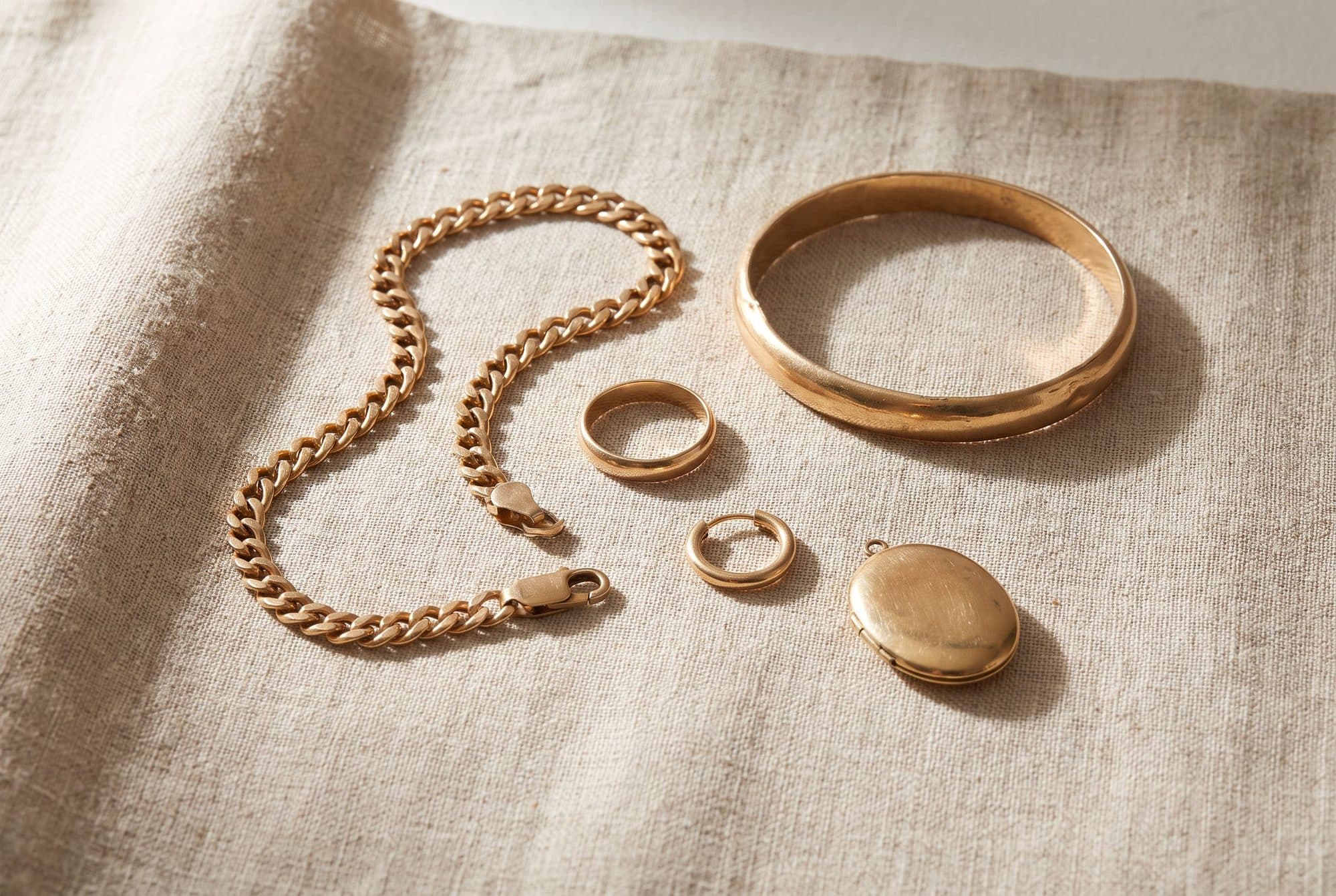
Illustration Computer-generated, not a customer’s lot.
- Asking firstfree, with no obligation
- Sortingnone; send it mixed
- Marks we read375, 585, 750, 916, 990, 999
- What comes backone written offer for the lot
- If you say noall of it returned, tracked, free
In short
Selling gold by post here takes one decision, made at the end. Send photographs and you are told, free and with no obligation, what the marks suggest. What it is worth turns on carat, on the weight of the gold once clasps, stones and movements are set aside, and on the gold price the day it is weighed — so no figure is quoted before a piece has been handled. If it is worth posting, a prepaid tracked label comes to you. Every piece is listed, weighed and tested, one written offer covers the lot, and whatever you decline comes back at our cost.
Start with photographs, not a parcel
Most people selling gold are clearing a drawer, not selling a bar. In it there is a snapped 9ct chain, one earring whose twin went years ago, a signet ring nobody wore and four or five things with no mark at all. You do not have to work out what any of it is. Photograph it, send us the pictures, and a person will tell you what we can see.
Asking costs nothing and ties you to nothing. Tip the lot out on a plain kitchen table in daylight. Take one picture of everything together and a few close ones of any marks you can find, then send them on WhatsApp. A person reads them and writes back with what the marks suggest, what looks like it may not be gold at all, and whether the lot is worth the trouble of posting.
We would rather tell you not to bother than take in a parcel that was never going to come to anything. If the chain turns out to be rolled gold and the earrings gilt brass, you have spent twenty minutes finding that out, and your things never left the house.
- One picture of the whole lot, so we can see how much there is.
- A close, steady picture of any mark: inside a ring shank, on a clasp, on the stem of a chain, on the back of a pendant.
- Both sides of anything with a stone in it.
- Something ordinary beside any piece whose size is hard to judge; a teaspoon or a bank card will do.
- Anything you already know: who it belonged to, where it came from, whether it was ever mended.
If you are unsure what to photograph, the page on sending photographs first sets out what a picture can and cannot settle. The reply is in writing, so you can read it twice or show it to someone else before you decide anything.
What a real box of gold usually holds
Very little of it looks like jewellery any more, and none of that matters. A bent piece weighs what it weighs and a snapped chain holds exactly as much gold as it did when it was whole. Nothing here is turned away for being broken, tangled, scratched, out of fashion or missing its partner.
- Chains that snapped at the clasp and were put in a drawer to be mended one day.
- Single earrings, usually two or three of them, none of them matching.
- A signet ring, often with worn-away initials and a hallmark you can just about feel with a thumbnail.
- Wedding and engagement rings from a marriage that ended, sometimes still in the box.
- A bangle that has been bent out of round, and a charm bracelet with half its charms gone.
- Cufflinks, collar studs, a tie pin, a pocket watch chain with no watch.
- Pieces with no mark anywhere on them, which is the ordinary state of a great deal of older and imported gold.
- Two or three things that look like gold and are not, which is the part most people are quietly worried about.
Send it as it is. There is nothing to sort, clean or untangle, and a jumbled lot is treated no differently from one in tidy bags. Odd bits of silver and a white ring that might be platinum can go in too. Scrap and broken gold jewellery goes through a drawer like this piece by piece, and platinum, palladium or white gold explains the white rings.
Unmarked pieces, and the things that only look like gold
The hallmark is where we start, not where we finish. The UK approved finenesses for gold are 375, 585, 750, 916, 990 and 999, and gold of a gram or more sold in this country should normally carry one. A lot of older, imported and very light gold never did, and a modern lasered mark can all but vanish on a worn shank. An absent mark is a reason to test, not a reason to think less of a piece.
Where an X-ray fluorescence analyser is available, a piece is read with it. It is quick and takes nothing off the item, but only sees the outermost skin of the metal. That is the whole trouble with plating: gold on the surface and brass underneath reads as gold until you look somewhere the plating has worn through. So readings are taken at more than one place on a piece, including a worn edge or the inside of a shank, and anything that disagrees with itself goes to a second method.
- A magnet. Solid gold is not pulled by one. A firm tug means steel, usually a core or a clasp spring.
- A weighing in air and again in water, which shows up a hollow or plated piece that is lighter than its size suggests.
- An acid touchstone test, only with your written consent under clause 4.2 of the terms, where the mark and the reading still will not agree.
Fire assay is the one test that would settle a stubborn case outright, and there is no arrangement with a laboratory, so it is not something we can put to you. Where the evidence still will not settle, the piece is either priced cautiously with the limits written on your offer, or left out and returned at our cost. You are told which (clause 4.4).
How each of those works and where each one can mislead is set out on the testing and XRF page. If you suspect a piece is plated, the guide to plated, rolled gold, gold-filled and vermeil describes what the marks on each of them look like.
What decides what gold is worth
Almost everyone arrives with this question and nobody wants the answer to be “it depends”. It does depend, on four things, and knowing which four is more use than a number would be.
- Carat. 9ct is 375 parts gold in a thousand and 22ct is 916. Two rings of identical weight can be worth two and a half times one another, and the difference is stamped on them or it is not.
- Weight, of the gold alone. Clasps, springs, watch movements, stones and their settings are weighed and set aside. A heavy piece can hold very little gold.
- Whether it is gold at all. Plated, rolled gold and gold-filled pieces carry too little to recover. Testing settles that; a mark on its own does not always.
- The gold price on the day it is weighed. It moves daily, so any figure has a date attached whether or not anybody says so.
Nothing on this site turns those four into a number for you, and that is deliberate. An estimate made before a piece has been weighed and tested is a prediction about an object nobody has handled, and in this trade it is nearly always the high one — which is how a seller ends up posting a parcel on one figure and being offered another.
The photograph does the useful part instead. Marks read from a clear picture tell you what carat you are probably looking at, what looks plated, and whether anything ought to be seen by a specialist before it is weighed at all. That is free, it is in writing, and it happens before anything leaves your house. What a photograph can and cannot settle sets out where the limits are.
Everything is listed before anything is decided
Your parcel is photographed before anybody opens it, with its label and any seal still intact, and only then is the lot unpacked. Each piece is laid out on its own, given a number, photographed and weighed on a calibrated balance. Nobody forms a view about the parcel as a whole until every item in it is on the list.
You see that list before you see anything else. It describes what arrived plainly enough to match against what you remember putting in. Item four, a broken curb chain, 9ct, marked; item five, a single earring, unmarked, tested as gold; item six, a gilt brass brooch, not gold. If something you expected is not on it, we stop and tell you before any offer is written (clause 8.3).
- Every item numbered, photographed and weighed, including the ones that turn out to be worthless.
- The marks found on each piece, and where on the piece they were found.
- What each test said, and where on the item the reading was taken.
- Stones, springs, movements and other things that are not gold, identified and left out of the weight, by estimate while they are still in place.
- Anything held back for a closer look, with the reason written beside it.
One written offer, for the lot
We price the lot, not the gram. What comes back is a single figure for everything we are buying, in writing, alongside the list of what that figure covers and the list of what it does not. There is no arithmetic for you to do and no moving number to keep an eye on. It is one decision, taken once, at whatever hour suits you.
A drawer of mixed, broken, half-identified jewellery is not one figure multiplied by a weight. It is forty small judgements: what each piece is, which part of it is not metal, what ought never to be scrapped, and what the lot is worth to us as a whole. The offer is where that work ends, and the list of items is the evidence behind it; clause 5.1 of the terms sets out what that list must show.
No period has been set for how long an offer stands, so this site quotes none, and neither does the offers, returns and payment page. You will not be told to hurry. If an offer lapses, your items stay where they are until you ask for a fresh offer or for the lot back (clause 5.2). If you need longer, you only have to say so.
Nothing is sold until you say yes
Saying yes is a thing you do, not a thing that happens to you: you press the button in your offer or tell us in writing (clause 6.1). Silence is never agreement, and nothing is melted, sold on or changed while you think about it. If you want a week and a conversation with your sister first, take the week.
If you say no, the whole lot comes back by tracked, signed-for post and it costs you nothing. You can also keep part of it: say which pieces you want back, the ring for instance, and a fresh written offer comes for the rest. That fresh offer can be lower than the weight removed suggests, because a lot is priced as a whole, and the first offer stays open for you to go back to (clause 6.3). The ring comes home as it arrived, stones and all, and nobody rings you to talk you round.
No number of working days has been set for sending a return back out, so none is quoted here. What is certain is the direction of travel: declined items go back to the address they came from, tracked, at our cost. The guide to declined offers and returns covers the rest.
The pieces we stop and flag
Some things are worth more as themselves than as metal, and scrapping them without a word would be the easy thing to do. So they are pulled out of the lot first, and you are told which ones and why before anything is priced as metal (clause 4.4). If a specialist, an auction or a private sale looks likely to do better for you, we say so, and you can have the piece back to try.
- Sovereigns, half sovereigns, Britannias and other coins, which are checked as coins first. See gold coins and sovereigns.
- Early date letters, provincial marks and period construction, which put a piece in front of someone who knows antique jewellery.
- Signed and designer work, with its signature, serial number, box and papers photographed.
- A watch that still runs, or carries a name worth knowing, which is assessed as a watch before its case is ever weighed. See gold watches.
- Larger or certificated stones, which are looked at in their own right rather than just left out of the weight.
- Anything that arrived as a complete set, because a set broken up is usually worth less than a set kept together.
Why this one matters
The Office of Fair Trading investigated gold-by-post buyers between 2009 and 2011. Its concerns included sellers pressed to reject a payment within a short time or have their gold melted. It was also concerned about unclear information on insurance in the post and on whether stones were bought, returned or put at risk. Waiting for your yes, putting the cover in writing before you post and listing every stone answer those concerns, and they are why this page is arranged as it is.
A person handles it, and where to begin
One person takes the lot from the moment it arrives to the moment you are paid or your things are on their way home. They open it, list it, test it, write the offer and answer you when you query it. There is no queue to be passed along and no department that has not seen your items.
Begin by sending photographs. If you already know what you have and simply want it gone, request a prepaid label and skip that step. If the gold came from a relative's house or an estate, say so: an inherited lot can be paused while the family decides (clause 10.3), and probate and estate jewellery explains how. What happens to your parcel once it is posted covers every stage, and for anything that does not fit, ask a question.
What we buy, and what we leave out
We buy
- 9ct, 14ct, 18ct, 21ct, 22ct and 24ct jewellery, hallmarked or not
- Broken, bent, tangled and incomplete chains, bracelets, rings and earrings
- Rings with stones still in them; a stone you ask for in writing is taken out after you accept and returned
- Gold coins and sovereigns, checked as coins before anything else
- Gold watch cases and bracelets, once the watch itself has been assessed
- Dental gold, crowns and bridges, tested for what is in the alloy
- Gold bars and bullion, with or without their paperwork
- Mixed lots nobody has ever sorted, including the bits you cannot identify
We do not buy
- Gold-plated, rolled-gold and gold-filled items, which hold too little gold to be worth recovering; vermeil is bought as the silver under it
- Costume jewellery and anything marked only with a plating grade
- Loose stones sent on their own
- Items you do not own or cannot account for
- Items believed to be stolen, or subject to a dispute between family members
Stopped before anything is treated as scrap
- Sovereigns and other coins are looked at as coins before they are ever treated as scrap
- Early hallmarks, date letters and period construction go in front of someone who knows antique jewellery
- Signed or designer pieces with serial numbers, boxes or papers are assessed for resale as they are
- Gold watches with a running movement or a known maker are valued as watches first
- Larger or certificated stones are considered in their own right
- Complete sets and heavy handmade work are considered whole before they are considered as metal
Questions sellers ask
Do I need to know what any of it is?
No, and most people do not. That is the work you are asking us to do. Send photographs of the lot and of any marks you can find. You get a plain reply about what appears to be gold, what does not, and whether posting it is worth your while.
Can I sell gold with no hallmark on it?
Yes. An unmarked piece is tested rather than assumed, with a magnet and by weighing in air and in water, and by XRF where an analyser is available. Acid on a touchstone is used only if you agree in writing. Nothing is marked down for being unmarked; it takes another test or two to establish what it is.
My pieces are all different carats and completely jumbled. Do I have to sort them?
No. Sorting is our job and we are better equipped for it than a kitchen table. Each piece is identified and tested on its own, so a 9ct chain sitting in the same bag as an 18ct ring changes nothing about either of them.
What happens to the stones in my rings?
Their weight is estimated and left out, and they stay in their settings unless you agree in writing to their removal. If you do and you accept the offer, they are lifted out where that can be done without damage, bagged, labelled with their item number and sent back to you. A stone that is large or comes with a certificate is flagged and looked at in its own right instead.
What if I do not like the offer?
Say no and it all comes back by tracked post at no charge. Or ask for just the pieces you are unsure about: they come back free, and a fresh written offer is made for the rest while the first stays open. Not replying is never taken as a yes. If the offer lapses, your items stay here untouched until you ask for a fresh offer or for them back, and nobody chases you.
Is my parcel covered while it is in the post?
The exact service and the level of cover that applies to your parcel are put in writing and sent to you with your label, before anything is posted. No figure of ours is printed on this page, because no carrier account has been opened yet. The risk in the post is ours in both directions on a label we issued (clause 7.2). The packing rules, and what to do when a parcel is worth more than one label sensibly carries, are on the security and insurance page.
Sources
Related
- Send photos first
- Request your postal pack
- How it works
- Sell online
- Sell silver
- Inherited jewellery
- Probate and estates
- Testing and XRF
- Security and insurance
- Offers, returns and payment
- Scrap gold jewellery
- Gold coins and sovereigns
- Gold watches
- Reading UK hallmarks on gold, silver, platinum and palladium
- Gold plated, rolled gold, gold-filled and vermeil compared
- Stones, clasps and the parts of a piece that are not metal
Not sure what you have? Start with photographs.
Photograph the lot: the tangled chains, the single earrings, the canteen nobody uses, the bits you cannot identify. Send it over and you get a rough idea back, with no pressure of any kind. Post it afterwards if you want to, or do not.
Nothing is sold until you say yes. Decline and it all comes back by tracked post, free; ask for part of it back and a fresh offer is made for the rest.
If a piece is worth more than its metal
A signed brooch, a date-run sovereign, a watch that still runs, a piece of early silver: anything that looks worth more whole is flagged to you before it is treated as metal, and you can take it back at that point.