Gold
Sell scrap and broken gold jewellery
Broken chains, single earrings and rings that stopped fitting are bought by post, a whole drawer at a time. Some of it will be gold and some will only look it, and you do not have to know which before you send it.
Send a photograph and a person looks at it. They tell you what the pieces are, what is plated rather than solid, and which ones are worth posting. Nothing is committed either way, and nobody chases you afterwards.
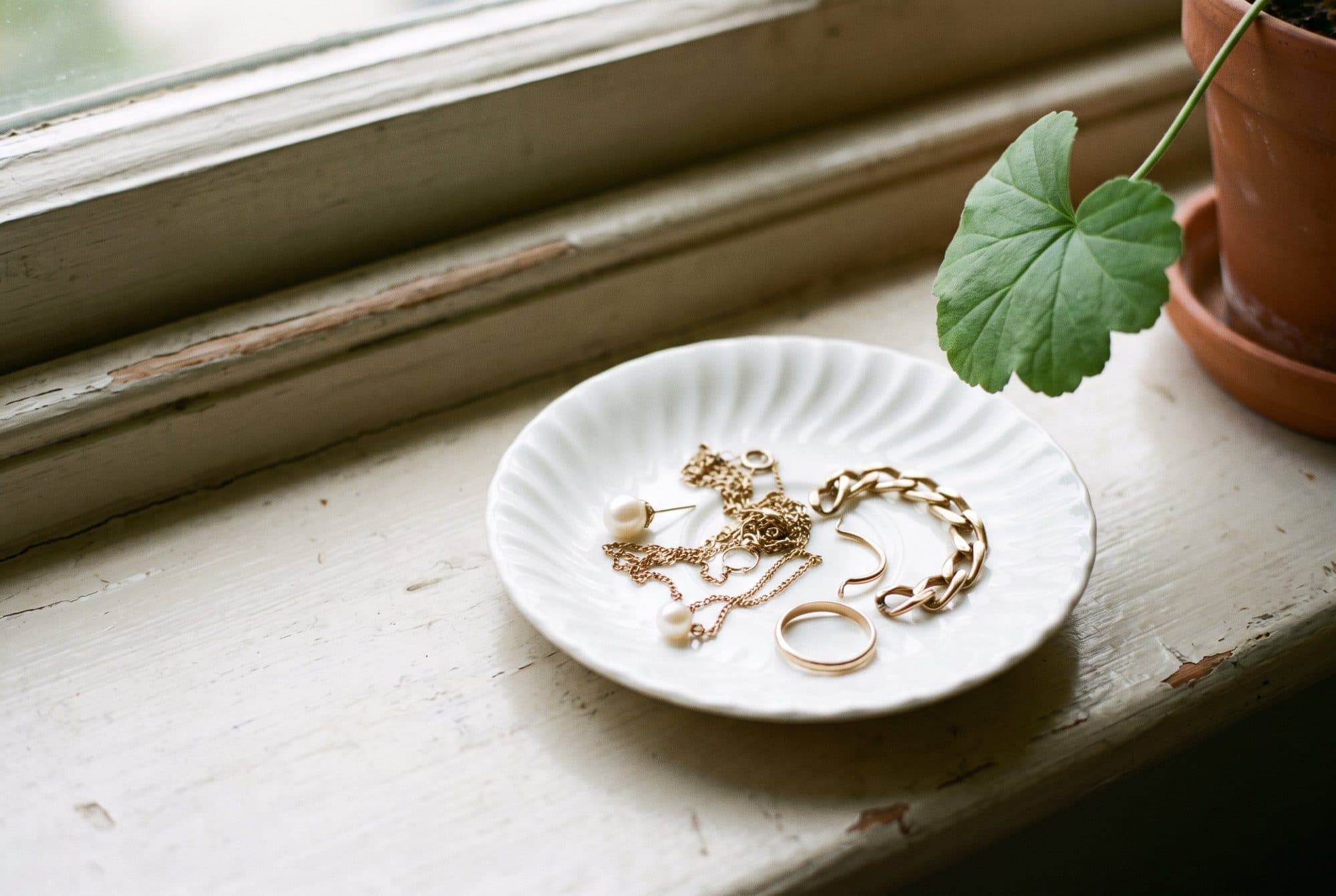
Illustration Computer-generated, not a customer’s lot.
- Carat marks375, 585, 750, 916 (9ct, 14ct, 18ct, 22ct)
- Not goldGP, GEP, HGE, RGP, GF, 1/20 12K GF, vermeil
- Often unmarkedimported 21ct and 22ct, very old thin pieces
- Left out of the weightstones, clasp springs, enamel, pearls
- Damagemakes no difference to the gold
In short
Broken, bent and odd pieces are bought exactly as whole ones are, because damage does not change what a piece is made of. Send the drawer as it stands, mixed carats and all. Every piece is looked at under magnification, weighed and tested, and one written offer covers the lot, with plated and base-metal pieces named and posted back.
What gold looks like after years in a drawer
Gold barely tarnishes: an 18ct chain kept in a jewellery box since 1978 comes out the colour it went in. Nine carat, which is mostly other metals, may darken a little but never goes black. What gold does do is go dull, collect grey fluff in the links and pick up a film from skin and perfume. Silver in the same box will have gone black and brass dark and slightly green at the joins, so a piece that stayed yellow while everything around it changed is worth looking at twice.
Colour on its own settles nothing. Nine carat is a pale, slightly straw yellow because it is more than half other metal; twenty-two carat is deep and almost orange. White gold is a faintly yellow grey under its rhodium plating, rose gold is pink from copper, and a brass curtain ring can sit in the middle of all of them and look convincing. Weight in the hand is a better clue than colour: gold is dense, and a solid piece feels heavier than its size suggests.
- Broken chains, knotted chains, single lengths with no clasp, and clasps with no chain
- Single earrings, earrings with the butterfly missing, and pairs you never wore
- Rings that were resized, cracked or worn thin at the back, or are simply the wrong size now
- Bracelets and bangles with links gone, charms off a charm bracelet, and cufflinks without partners
- Brooch frames with the pin snapped, pendants with the bail pulled through, tie pins and collar studs
- Anything you cannot name at all, which in most drawers is a fair proportion of it
The carat numbers, and where they hide
British gold carries a hallmark struck by an assay office, and the part of it most people can read is the millesimal number: the parts of gold per thousand. You will need a magnifier and good light. The marks are tiny and often half worn away, and on a ring they sit inside the shank where your finger has been rubbing them since the 1960s.
Gold fineness marks and what they mean
| Mark | Carat | What it tells you |
|---|---|---|
| 375 | 9ct | The commonest British gold. Just over a third gold, the rest copper and silver. |
| 585 | 14ct | Less usual in Britain, very common on American and German pieces. |
| 750 | 18ct | Three quarters gold. Deeper colour, softer, used for better rings and settings. |
| 916 | 22ct | Eleven parts gold in twelve. Indian, Middle Eastern and Asian jewellery is often this, and often unmarked. |
| 999 | 24ct | Pure gold. Rare in jewellery because it bends; usual in bars and some Asian pieces. |
- Inside a ring shank, opposite the stone or opposite the join
- On the flat tab soldered beside a chain clasp, or on the clasp itself
- On the post or the butterfly of an earring, which is often where the only mark on a pair is
- On the edge of a pendant bail, under a brooch pin, on the inside of a bangle near the hinge
No mark at all is normal and it is not a bad sign. Gold under one gram does not have to be hallmarked, a great deal of jewellery came into the country in a suitcase, and very fine chain is too thin to strike. An unmarked piece is one where the test does the work the mark would have done. The UK hallmarks guide shows the whole mark, office by office.
The pieces that only look like gold
Plated jewellery is base metal with gold on the outside, and when it is new it is indistinguishable from the real thing. The layer is measured in millionths of a metre. There is not enough of it to recover, so a plated chain is worth nothing as metal however convincing it looks, and it is listed and sent back to you (clause 11.1). The guide to plated, rolled gold and gold-filled pieces shows how each is built.
- GP, GEP, HGE
- Gold plated, gold electroplated, heavy gold electroplate. A skin of gold on brass or nickel.
- RGP, GF, 1/20 12K GF
- Rolled gold plate and gold-filled. A thicker layer, bonded rather than plated, but still a small fraction of the weight: 1/20 12K means one twentieth of the weight is 12-carat gold. Common on old watch chains and Edwardian brooches.
- Vermeil
- Gold over sterling silver. The gold is a skin; the silver underneath is real, so the piece is bought as silver.
- Doublé, plaqué, rolled gold
- The French and older British names for the same construction. Usually stamped on the back of a brooch or inside a bangle.
- No mark, wearing pink
- The giveaway on plate. Where a plated piece has rubbed — a ring shank, a chain edge, the high points of a brooch — copper or grey nickel shows through.
The magnet test, and what it does not prove
Gold is not magnetic. If a fridge magnet grabs a chain firmly, there is steel in it. But a gold clasp with a steel spring inside will give a small tug, and plated brass is not magnetic either, so a magnet rules things out far better than it rules them in. It is worth thirty seconds and no more.
Please do not file, scrape or acid-test anything at home. The kits sold for it cut a notch in the piece to reach bare metal, and a notch in a signed Victorian brooch takes real money off something that was never scrap. If you want to know before you post, photographs cost nothing, and what you can safely check at home covers the tests that leave no mark.
Send the whole tangle, not the one piece you are sure about
The common instinct is to pick out the two pieces that obviously say 375 and leave the rest, and it is the wrong way round. People are usually right about the pieces they are confident of. The value that gets missed sits in the ones they were unsure about, which is exactly the bag they left at home. Send all of it, including whatever you are convinced is rubbish.
- Do not untangle the chains. Knots come apart on the bench with tweezers and they do not affect anything.
- Do not sort by carat. Sorting is our work, and a mixed bag is the normal state of a drawer.
- Do not clean anything. Polish takes off a little metal and can wipe the detail off an old piece.
- Leave stones in their settings. Lifting them at home damages the claws and loses the stone.
- Leave clasps, jump rings and earring backs attached. Some of them are gold; the steel parts inside are left out of the weight.
- Costume jewellery can travel in the same parcel. It is separated, listed and posted back with anything else you decline.
- A drawer of gold is small but can be valuable. Tell us roughly what is in it before you post so the right service is used; security and insurance explains how it should be packed and covered.
If the drawer belonged to someone who has died, send it as you found it rather than trying to work out what mattered to them. Things people kept together often belong together, and a parcel that arrives sorted into bags by a family member is no easier for us and sometimes loses the one thread worth following.
Photographs first are the cheapest step and the one we would rather you took. Tip the drawer onto a plain tea towel, take three or four pictures, and send them on WhatsApp. You get a rough idea of what is there and whether it is worth posting, and nothing leaves the house until you have decided.
Everything we buy, and what comes back has the rest of the list, and inherited jewellery covers a drawer that came from a relative. Coins, bars and watches are on selling gold by post and the pages it links to.
What happens to a bag of mixed gold when it arrives
- Booked in as one lotThe parcel is photographed unopened, then its contents are counted and photographed together under your reference. Nothing is separated before that record exists.
- Laid out and identifiedEvery piece is looked at under magnification, marks read and noted, and the obvious plate set to one side. Anything that might be worth more as it stands comes out here.
- Weighed and testedPieces are weighed on a calibrated balance, checked with a magnet and, where the shape allows, weighed in water. Where an analyser is available they are also read by X-ray fluorescence (XRF), at more than one point. A surface reading on a worn edge tells you something a reading on a polished face will not; see testing and XRF.
- ItemisedYou get a list of what arrived, described piece by piece, with the plated and base-metal items named and the reason they are not gold.
- One offer for the lotA single written offer, sent to you to think over. Nothing is sold, melted or altered until you say yes, and declining costs you nothing; offers, returns and payment sets out each answer you can give.
Stones, enamel and pearls are not metal and steel springs are not gold, so their weight is estimated in place and left out. Stones stay in their settings unless you agree in writing to their removal (clause 4.2). If you do and you accept the offer, they are lifted where that can be done without damage and posted back to you; where lifting would break the setting, the piece is left intact. The stones and non-metal guide explains what in a piece is not metal and why.
The pieces in the bag that should never be melted
Anything worth more intact is flagged first
A signed brooch, an early hallmark, a coin mounted in a pendant, a stone larger than a chip, a complete charm bracelet: these can be worth more as objects than as metal. They are picked out and you are told before anything is priced, and they come back to you if you would rather take them elsewhere. Gold can be melted next week. It cannot be un-melted.
This is the check people most want, so it happens before anything is weighed rather than after. It costs you nothing and it is the reason the identification stage above is slow. If a piece belongs with an auction house or a specialist dealer instead, we say so plainly, and it goes back to you free whether or not you sell us the rest. A coin in a pendant mount is looked at as a coin first, for the reasons on gold coins and sovereigns.
What we buy, and what we leave out
We buy
- Broken and knotted chains of any carat, including odd lengths and loose clasps
- Single, mismatched and damaged earrings
- Bent, cracked, resized or worn-through rings and wedding bands
- Snapped bracelets, bangles and loose links
- Charms, pendants, cufflinks, tie pins and brooch frames
- Unhallmarked gold, including imported 21ct and 22ct
- Mixed carat lots, sorted or unsorted, and whole drawers tipped into a bag
- Pieces with stones still in them
We do not buy
- Gold-plated pieces marked GP, GEP or HGE, or unmarked plate
- Rolled gold and gold-filled pieces marked RGP, GF or a fraction such as 1/20 12K GF
- Vermeil, except for the sterling silver underneath the gold
- Costume jewellery and base-metal findings
- Loose stones with no metal attached
- Items you do not own or cannot account for
Stopped before anything is treated as scrap
- Chains, rings and bracelets with a maker's signature or a serial number are checked as second-hand pieces first
- Early hallmarks and hand-made construction are checked against antique resale
- Rings with larger or certificated stones are held so the stone can be valued in its own right
- Named-maker charms and complete charm bracelets are assessed as they are
- A coin mounted as a pendant is checked as a coin before the mount is treated as metal
- Where a piece belongs at auction or with a specialist we say so in writing, and post it back free
Questions sellers ask
Is broken gold worth less than gold that is not broken?
No. A snapped chain holds exactly as much gold as it did the day before it snapped, and it is bought on the same footing as a whole one. The only thing damage takes away is value a piece had as an object, which for most everyday jewellery was small to begin with.
Do I need to sort my gold by carat before sending it?
No. Every piece is identified and tested here whatever order it arrives in, and a mixed bag is the normal state of a jewellery drawer. Sorting is our job, not yours.
Will you take gold with no hallmark?
Yes. A good deal of older and imported gold has none: 21ct and 22ct from abroad is very often unmarked, and fine chain is too thin to strike. An unmarked piece is tested rather than assumed, and the result is written down.
What happens to the plated pieces I send by mistake?
Nothing awkward. They are picked out, named on the list with the reason, and posted back to you with anything else you decline. It is an easy mistake to make and it costs you nothing.
Should I take the stones out before posting?
Please do not. Lifting a stone without the right tools damages the claws and the stone, and loose stones get lost in the post. Their weight is left out here, and if you agree in writing to their removal they are taken out after you accept, where it is safe to, and sent back to you.
Can I send the whole jewellery box, including the things that are obviously not gold?
Yes, and it is the better way to do it. Separating is the part we are set up for. Costume pieces, silver and things nobody can name all travel fine in the same parcel and come back to you if they are not something we buy.
Sources
Related
- How it works
- Send photos first
- Request your postal pack
- Sell gold
- What we buy
- Inherited jewellery
- House clearance
- Testing and XRF
- Security and insurance
- Offers, returns and payment
- Gold coins and sovereigns
- Gold watches
- Platinum and palladium
- Reading UK hallmarks on gold, silver, platinum and palladium
- Gold plated, rolled gold, gold-filled and vermeil compared
- Stones, clasps and the parts of a piece that are not metal
- How to test gold at home: which checks mean something, and which will damage it
Not sure what you have? Start with photographs.
Photograph the lot: the tangled chains, the single earrings, the canteen nobody uses, the bits you cannot identify. Send it over and you get a rough idea back, with no pressure of any kind. Post it afterwards if you want to, or do not.
Nothing is sold until you say yes. Decline and it all comes back by tracked post, free; ask for part of it back and a fresh offer is made for the rest.
If a piece is worth more than its metal
A signed brooch, a date-run sovereign, a watch that still runs, a piece of early silver: anything that looks worth more whole is flagged to you before it is treated as metal, and you can take it back at that point.