Sell gold and silver online, without going anywhere
Selling online to Assaypost means the whole thing happens by post and in writing: no shop, no appointment, no stranger at the door. There are four steps, from a free look at your photographs to payment or a free return. Nothing is sold until you say yes, and silence is never taken as a yes.
Photographs first; posting only if you decide to.
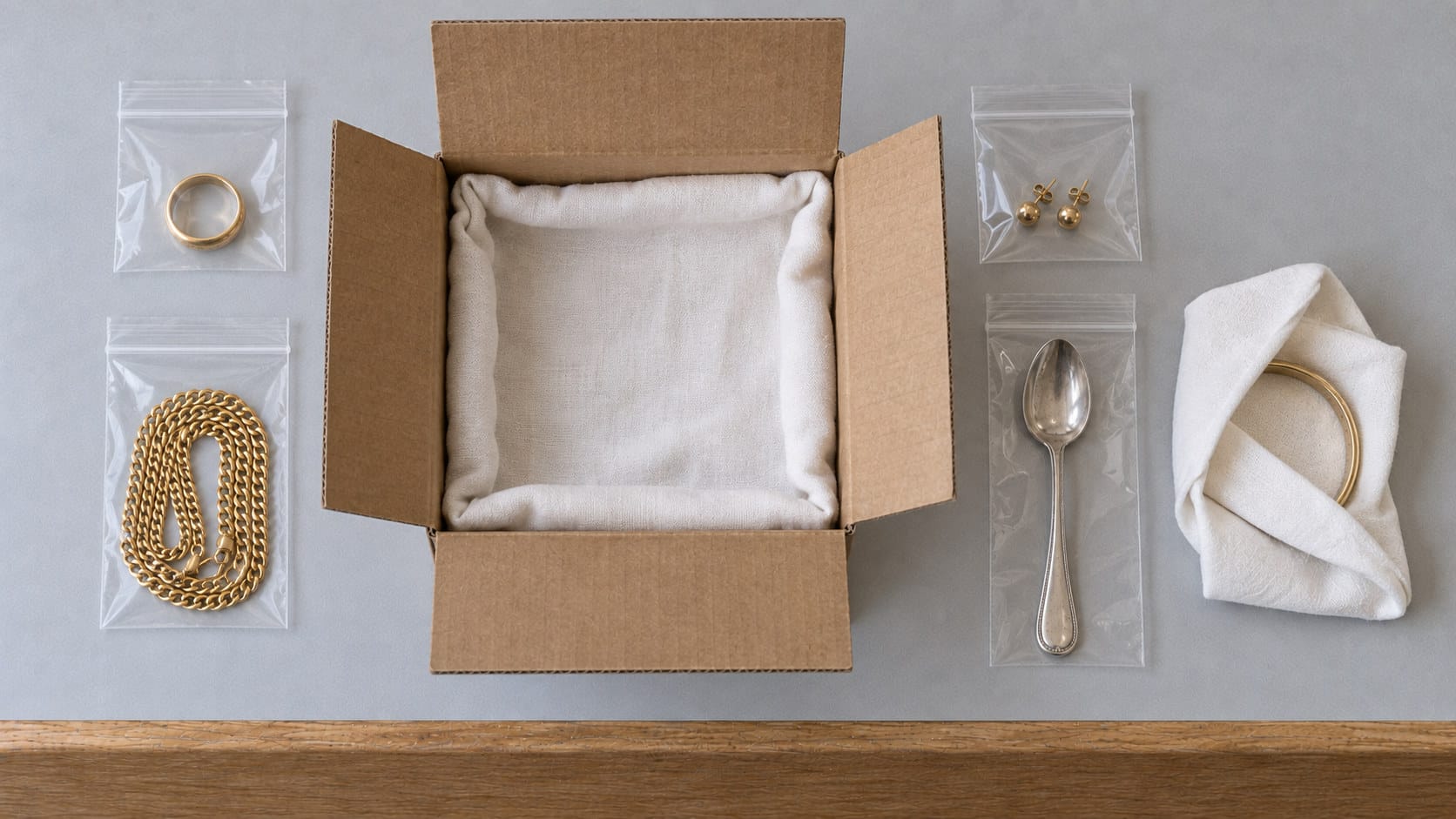
Illustration Computer-generated. Not our bench and not a customer’s lot.
- Shop to visitnone; all of it by post
- Step onephotographs, before anything moves
- Postagearranged with you, service and cover confirmed in writing first
- On arrivalphotographed sealed, then listed
- Saying nothingnever counts as a yes
In short
Selling gold or silver online in the UK means selling by post, without meeting anybody. Send photographs first for a free rough idea; if you decide to post, we arrange the postage with you and confirm the service and its cover in writing first. Every piece is listed, weighed and checked before one written offer covers the lot: accept and you are paid by bank transfer, decline and everything comes back at our cost.
Ask before you post anything
This page sets out every stage in order, what is recorded at each one, and the two points where the decision is yours.
Nobody should post a box of valuables to find out whether it was worth posting. Send photographs first, on WhatsApp to 07369 296063. If you do not use WhatsApp, ring or text the same number, 6am to 10pm, seven days. A person looks at them and writes back with a rough idea: what the marks suggest, what is probably not precious metal at all, and whether the lot is worth posting. It is free and commits you to nothing, and sometimes the answer saves you a trip to the post office.
This is also the point to mention anything unusual. Say if the lot came out of an estate, if you are selling for somebody else, if one piece matters to you and should be flagged rather than bought, or if there are forty items and you have photographed six. The reply is in writing, so you can read it again, or show it to somebody else, before you decide.
The whole thing, in four steps
- Send photographsYou send photographs and get a rough idea back, free and with no obligation. If the answer is that it is not worth sending, that is the end of it and nothing has left your house.
- Post it, when you are readyIf you want to go ahead, we arrange the postage with you and confirm the service and its cover in writing before anything is sent, with a reference number that follows the parcel. Tell us roughly what is going in, so the right service is used, then pack it, hand it in and keep the receipt. There is no deadline.
- Assessment and one offerThe parcel is photographed unopened, then logged against your reference. Every piece is separated, numbered, photographed, weighed and checked for its metal; each coin gets its own line, and coins of the same standard may be weighed and checked in groups, with the coins checked named. One written offer for the lot then comes to you, with the list of everything that arrived beside it, showing what is being bought, what is not, and what has been set aside as possibly worth more whole.
- Your decisionAccept and you are paid by bank transfer to a UK account in your own name; payment timing is stated on your offer. Decline and everything is posted back by tracked, signed-for post at our cost; ask for part of it back and a fresh written offer is made for the rest. Say nothing and nothing is sold.
The same four steps apply to a single piece and to a house's worth of cutlery. The service is built for boxes and bundles, and a single piece is welcome to ask first. How it works covers the same ground with the paperwork alongside it, and what is bought, metal by metal, is on selling gold and selling silver.
Getting it there, and what protects it on the way
When you are ready to post, we arrange the postage with you and confirm the service and its cover in writing before anything is sent. Tell us roughly what you are sending, so the right service is used.
On postage we arrange, the risk in the post is ours in both directions: from the moment the counter accepts your parcel, and on any return until it is delivered to you (the terms, clause 7.2). If something is lost or damaged, what you are owed is what the items were worth, not what we would have offered, and it is not capped at whatever the carrier pays us (clauses 12.2 and 12.4). If we cannot agree the value, an independent valuer decides at our cost.
- Pack it so nothing rattles: a rigid inner box with padding on all six sides, inside a plain outer box.
- Nothing on the outside should name a metal, a buyer or a value.
- Hand it over and keep the receipt with its tracking number. It is how a parcel is traced, and if you lose it you are still owed everything you would have been.
- Photograph the contents and the sealed parcel yourself before you go. It takes a minute, and if anything is ever disputed your photograph counts as evidence alongside ours.
- If the lot is heavy, bulky or worth more than one parcel should sensibly carry, ask first and we agree how to split it. Tell us in writing that the parcels belong together and we wait for the last before making one offer; when we agree a split, we ask whether you want one offer for all the parcels or a separate offer for each.
The packing rules in full, what to do if a parcel is delayed or turns up damaged, and how a claim is made are on posting safely and cover. The guide to posting gold and silver safely walks through the packing itself, box by box.
When it arrives: photographed first, opened second
Your parcel is photographed before anybody touches the tape: the outer packaging as it arrived, the label, the tracking number and any seal, all still intact. That photograph is our record of the state the parcel was in when it reached us, and it is taken whether the box looks perfect or battered.
Only then is it opened, and the contents are laid out and gone through piece by piece. Everything is separated and given a number. Each item is photographed and weighed, and its marks are read under magnification before any other check is made. Stones, steel blades and springs, glass liners and wooden handles are identified and left out of the weight. Where they are still attached, the weight left out is estimated, and the estimate and how it was made are shown on that item's line.
The result is a list of what arrived, in plain language, and you get it whatever happens next. It answers the question that makes people nervous about posting, which is how you know what was actually received: it is written down, item by item, with photographs, before anyone puts a figure on any of it. If it does not match what you told us you were sending, we stop and write to you before anything else is done.
One offer, for the lot, in writing
We make one offer for everything you send. What reaches you is a single figure for everything being bought, in writing, next to the list of what it covers and the list of what is coming home regardless. What you check is the list: every piece, its weight and what it was found to be. You are free to compare the offer with any other before you decide.
It names the things that are not being bought, and why: the gilt brooch that is not gold, the electroplated servers, the ring you asked to have flagged rather than sold. Anything held back as worth more whole is named too. A question about any line goes to the person who had your things in their hands.
We confirm the offer period in writing with every offer. If you need longer, ask; the offer is kept open and nobody asks why (the terms, clause 10.2).
Yes, no, or nothing at all
Accept an offer and payment goes by bank transfer to a UK account in your own name, never to a third party. Decline it and everything is repacked and posted back to the address it came from, by tracked, signed-for post at our cost. Do nothing and nothing is sold, and no email arrives to say the offer has been taken as accepted. If the offer period ends without an answer, your things stay here untouched until you ask for a fresh offer or for them back.
You can also keep part of it. If you want a ring back, say so; we send it back and make a new written offer for the rest. Because the first figure covered the whole lot, the second is worked out afresh for what remains. The first stays open for you to go back to (the terms, clause 6.3). The ring comes home as it arrived, and nothing is melted, altered or sold on while a decision is outstanding.
When a declined lot is posted back, we tell you and give you the tracking number. Nobody will ring to change your mind or send an improved offer to keep you talking, and declining costs you nothing. See declined offers and returns.
Anything worth more whole is stopped before it is touched
A scarce sovereign sold for its gold can lose its collector value for good. So coins, early hallmarks, signed work, watches by known makers whether or not they run, larger stones or stones with a certificate, and complete sets are set aside first. Before any offer, we tell you which and why: they may be worth more to a specialist, an auction house or a dealer, and you can take the piece back to try it. We are a buyer, not a specialist, so if you already suspect a piece matters, ask a specialist first.
The pages on gold coins and sovereigns, gold watches and silver tea sets and hollowware go through what gets stopped in each. The guide to antique silver against scrap sets out the questions to ask.
Who handles it, and why you are asked for identification
One person takes your parcel from the moment it arrives to the moment you are paid or your things are back on the doormat. They open it, list it, check it, write the offer and reply when you ask a question about it.
Before a first payment you will be asked to prove who you are and that the bank account is yours. Every seller is asked. It stops somebody else selling your things, and it keeps us clear of the proceeds-of-crime and stolen-goods offences explained on the responsible sourcing and AML page.
- A photograph of one government-issued photo identity document, checked against the name on the bank account and deleted on the schedule in the privacy notice.
- Payment only into a UK account in the seller's own name. If you are selling for somebody else, or for an organisation that owns the items, tell us before you post: we confirm in writing what authority is needed and whose account is paid, before anything is sent.
- Plain questions about where an unusual item came from, and for inherited pieces something showing you are entitled to sell them, such as a grant of probate or a letter from the executor. If you are selling for somebody else, we need their written authority and their identity as well as yours.
- If an item has been reported stolen, we report it where the law requires and may report it voluntarily, as the privacy notice explains. Keeping your own photographs and receipts protects you too.
Which documents are accepted, and why each one is asked for, is set out in the guide to identity and provenance checks.
If something goes wrong
- The parcel is late, or stops moving
- We check the tracking, raise it with the carrier and keep it open until it is resolved. On postage we arranged, the risk in the post is ours, so any claim is ours to make, and you are told what is happening rather than left to chase it.
- Something you sent is not in the box
- The photograph of the unopened parcel and the list made on opening are compared with what you said you sent. If they differ, we stop and write to you before any offer is written, and your own photograph counts as evidence alongside ours (the terms, section 8).
- A weight does not match yours
- Kitchen and luggage scales are rarely reliable on small weights. Your list shows the weight we recorded and a photograph of the item, so the two can be compared.
- It turns out not to be precious metal
- The list says so and names the check that showed it. The item is posted back with anything else you decline, or on its own, and there is nothing to pay either way.
- You change your mind
- Ask for everything back at any point before you accept, even before the offer is made, and it comes home tracked at our cost (the terms, clause 6.4). No reason is needed.
- You are unhappy with how it was handled
- The complaints page sets out three stages and who owns each. Separately, if something of yours is lost or damaged and we cannot agree what it was worth, an independent valuer decides and we pay (the terms, clause 12.3).
What we buy, and what we leave out
We buy
- Gold jewellery of any carat, hallmarked or not, whole or broken
- Gold coins and sovereigns, bars and dental gold
- Sterling, Britannia and continental silver, including cutlery, hollowware and jewellery
- British silver coins dated before 1947, Maundy money and silver proofs, foreign silver coins of a known standard, and silver bars
- Platinum and palladium jewellery and scrap
- Gold watches: a watch by a known maker, running or not, is flagged before the case is considered as metal
- Vermeil, bought as the silver under the gilding
- Mixed, unsorted boxes where nobody knows what is in them
We do not buy
- Gold-plated, rolled-gold and gold-filled items
- Electroplate marked EPNS, EP, A1 and the like
- Stainless steel, costume jewellery and base metal
- Loose stones sent without their settings
- Items you are not entitled to sell (if you inherited something and have no paperwork, ask us first)
Stopped before anything is treated as scrap
- Coins that may interest a collector are flagged before any is considered as metal
- Hallmarked antiques and early pieces are set aside, and we tell you they may do better with an auction house or specialist dealer
- Signed and designer work, with or without papers, is set aside and you are told it may be worth more as it stands
- A watch by a known maker, running or not, is flagged before any offer so you can take it to a watch specialist, an auction house or a dealer
- Larger stones, or stones with a certificate, are pointed out as worth having valued separately; we do not value stones
Questions sellers ask
Do I have to go anywhere or meet anyone?
No. The whole thing runs by post and in writing, and identification is done with documents rather than in person. There is no shop and no appointment; the only counter is the one you post from.
How will I know my parcel got there?
You have the tracking from your own receipt, and we tell you when it arrives. The photograph taken of it unopened, with the label and any seal intact, is part of the record you are shown.
How do I know what you actually received?
The list of items, with photographs and weights, is made before anybody puts a figure on the lot, and it comes to you with the offer so you can check it against your memory of what you packed. If the parcel does not match what you told us, you hear from us before any offer is made.
What if I disagree with the offer?
Say so. Ask about any item on the list and the person who handled it will answer. If you still disagree, decline the whole lot and it comes back tracked at no charge, or ask for just the pieces in question back and a fresh written offer is made for the rest, with the first still open. You are free to get other offers before you decide.
Why do you need my identification?
So that payment reaches the owner of the items and nobody else, and to keep stolen goods and the proceeds of crime out of the business. The documents are handled under the privacy notice and deleted on the schedule set out there.
How long does the whole thing take?
We do not quote a turnaround time. You are told when your parcel arrives, when the list and offer are ready, and when payment or the return has been sent; payment timing is stated on your offer.
Sources
Related
- Send photos first
- Posting your items
- How it works
- Sell gold
- Sell silver
- Inherited jewellery
- House clearance
- Posting safely and cover
- Offers, returns and payment
- How items are tested
- Responsible sourcing and AML
- Complaints
- Posting gold and silver safely
- Declining an offer and getting your items back
- Identity and provenance checks when you sell gold or silver
Ready to see how it starts?
The first step is a few photographs. A person looks at them and writes back. Posting comes later, and only if you decide to.
Nothing is sold until you say yes. Say no and everything comes back by tracked, signed-for post at our cost. Keep a piece back and you get a fresh offer for the rest.
No WhatsApp? Call or text 07369 296063, 6am to 10pm, seven days a week.
Nothing is committed early
Photographs commit you to nothing. Even after your parcel reaches us, everything in it stays yours until the payment for it reaches your account.