Silver
Sell silver cutlery and flatware
Sterling cutlery is bought by post, a whole canteen at a time. Plated pieces can travel with it; plate is not bought and comes back to you. Many canteens that come down from a loft are electroplate, made in huge numbers from the late Victorian period onwards, and one mark usually tells you which yours is.
Photograph the marks underneath; that answers most of it.
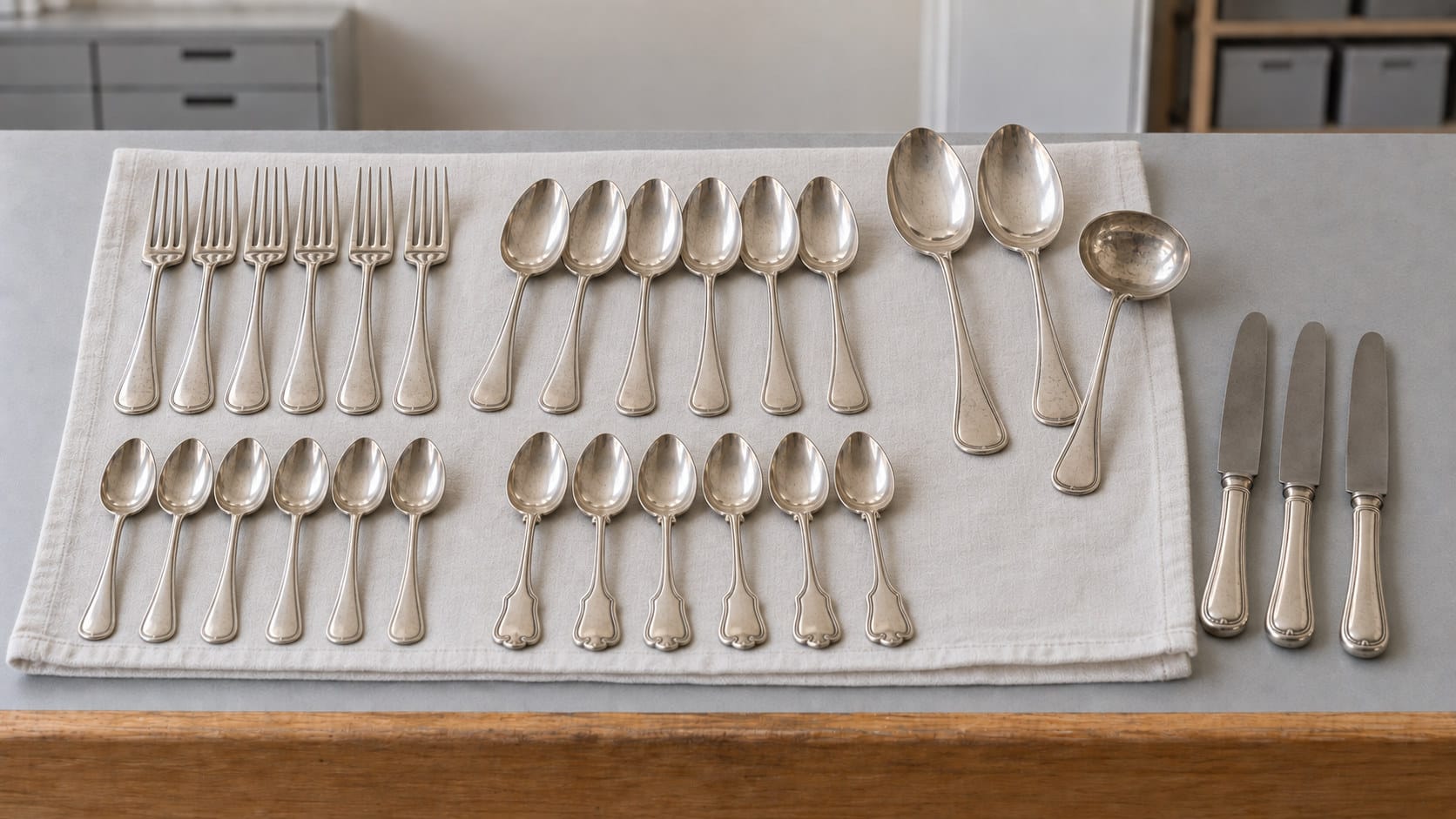
Illustration Computer-generated. Not our bench and not a customer’s lot.
- Sterling marka small walking lion, in profile, facing left
- Not silverEPNS, EP, A1, nickel silver, alpacca, German silver
- Continentaloften 800, 830 or 835, stamped rather than assayed here
- Knivesusually a thin silver handle filled with pitch around a steel blade
- Worth more wholecomplete named patterns, Georgian pieces, unusual servers
In short
Sterling forks, spoons and silver-handled knives are bought by post. A lion passant, or 925 with a British assay office mark, means sterling; EPNS, EP and A1 mean electroplate, which holds no recoverable silver and is not bought. Photograph the set first; every piece that is sent is identified, grouped and listed before one written offer is made.
The lion, and the marks made to look like it
Turn a fork over and look along the back of the stem, with a magnifier if you have one, because the marks are often worn nearly flat. British sterling carries a row of small punches, and the one that matters is a lion passant: a lion walking in profile with one front paw raised. Beside it sit the maker's initials, a symbol for the assay office that tested it, and a letter giving the year. Older Scottish silver carries a thistle (Edinburgh) or a lion rampant (Glasgow) in place of the lion passant, and Irish silver a crowned harp. On a piece marked since 1999 the lion is optional, and 925 in an oval with the office mark does the same job. The silver hallmarks guide shows where the marks sit on a spoon, a knife and a teapot, and how to spot a plater's imitation row.
Marks found on cutlery
| Mark | What it means | Silver? |
|---|---|---|
| Lion passant or 925, with a maker's mark and an assay office mark | British sterling, 925 parts per thousand | Yes |
| Thistle or lion rampant (Scottish), crowned harp (Irish), with an office mark | Sterling marked in Edinburgh, Glasgow or Dublin | Yes |
| A seated figure of Britannia | The higher British standard, marked 958 | Yes |
| 925, STERLING, 800, 830 or 835 with no assay office mark | A stamped claim from abroad or from an unassayed maker | Often, once checked |
| EPNS, EP, A1, EPBM, silver plate | Electroplate: a thin layer of silver on a base alloy | No |
| Sheffield plate | On a modern piece, a trade name for electroplate. On a piece made before about 1840, Old Sheffield Plate: silver fused to copper, which collectors buy | No, but early fused plate is worth showing to a specialist |
| A row of small marks with no lion, no 925 and no office mark | Pseudo-hallmarks, made to resemble the real thing | No, unless checks say otherwise |
The names are confusing. Nickel silver contains no silver: it is copper, nickel and zinc, and alpacca and German silver are the same alloy under other names. EPNS is that alloy with silver electroplated onto it, and A1 was a grade makers used for the thickness of the plating, not a standard of any kind. There is a fuller guide with EPNS, A1 and Sheffield plate explained, mark by mark.
The wear points can show plate
Plating wears off the high spots first. Look at the back of a spoon bowl where it has rubbed on years of plates, at the tips of fork tines, and at the heel of a handle. On plate a warm yellow or pink often comes through. Sterling wears just as much but stays white, because it is the same metal all the way through.
Why knives are not like forks and spoons
A silver-handled table knife is usually a hollow shell of thin sterling, filled with pitch or resin, with a steel blade cemented into the end of it. Pick one up and it feels heavy, but most of that weight is the filling and the blade. A set of twelve knives can look like the most substantial part of a canteen and hold the least silver. Some fruit, dessert and fish knives have silver blades, and those are bought as silver.
- Steel blades, tines and inserts are not silver, and their weight is left out.
- Pitch, resin, cement and plaster filling are left out too, by estimate. They are there for weight and grip, nothing else.
- Fish knives and forks often pair a sterling handle with a plated blade. The two parts are identified separately.
- Bone, ivory, horn, wood and Bakelite handles are not silver. A piece with an ivory handle is not bought, so send photographs of it rather than posting it; if one arrives anyway it comes back to you whole, with the handle still on it. The ivory guide sets out the law and its narrow exemptions, and our own rule is in the responsible sourcing policy.
- We never open a knife handle unless you have accepted our offer. Before that, the silver in each handle is estimated from its pattern and construction and shown on the list, and an accepted offer is not changed afterwards.
Knives are still worth sending, with the right expectation, and the list says what each knife is. Weighted and loaded silver shows the same construction in candlesticks and trophies.
Continental sets, souvenir spoons and the drawer of odds
Much of the cutlery in British homes is not British and was never assayed here. Continental flatware is commonly 800, 830 or 835 parts per thousand, and some is 875, 900 or 950, stamped with a number and sometimes a small national mark rather than a British hallmark. Below 925 it is real silver at a lower standard than sterling, and it is identified by checking the metal.
- Souvenir teaspoons with enamelled crests; the enamel is not silver, and the spoon may or may not be, so look for the marks.
- Christening spoons, caddy spoons, sugar tongs, mustard spoons and salt shovels, which turn up loose in drawers.
- Serving pieces that match nothing else, such as fish slices, marrow scoops, asparagus tongs, grape scissors and stilton scoops.
- Single pieces from sets long since broken up, and pieces with a crest or a monogram engraved on them.
- Pieces with no marks at all, including some very good early ones where the marks rubbed away a century ago.
Monograms and crests make no difference to the silver and can add interest to a piece worth keeping whole. Do not have them polished out, and please do not polish the set before sending it. Polish removes a little metal every time and softens an engraved crest for good.
Photograph the canteen, then send it
Photograph the marks first. If the photographs show which pieces are plated, you can keep those at home. If you are not sure, send the whole canteen in its box, with the knives and the odd pieces from another pattern; we sort it, and anything we do not buy comes back free. The exception is any piece whose handle might be ivory: photograph it and ask before posting.
- Leave the set in its canteen box if the box will survive the post, or wrap the pieces in bundles by type and put the box aside.
- Do not polish or wash anything. Tarnish does no harm, and you do not need to separate plate from sterling.
- Wrap knives so blades cannot cut through a bag, and keep anything with a wooden or bone handle dry.
- A full canteen is heavy. Tell us roughly what you have; when you are ready to post, we arrange the postage with you and confirm the service and its cover in writing before anything is sent. Posting safely and cover explains how to pack it.
- Canteen boxes are not bought. The box comes back to you at our cost.
There is one thing worth doing at home first, and it takes ten minutes: lay the set out on a table and count it, pattern by pattern. Photograph it laid out, photograph the marks on the back of one fork, and send both on WhatsApp to 07369 296063, or ring or text that number if you would rather describe it. A complete service for twelve in a named pattern can be worth more than thirty-odd assorted pieces of the same weight, and the count tells you which you have. If this is part of clearing a house, house clearance gold and silver covers sending everything together.
When a set should stay a set
A complete canteen may be worth more as a set
A full service for twelve by a recognised maker, in good condition, with its serving pieces, can sell better as a set than as silver, depending on maker, pattern and condition. A set like that is set aside before anything else happens, and we tell you before any offer that it may be worth more to a dealer or an auction house; it comes back free if you would rather try one. A mixed part set of several modern patterns is usually sold for its silver, and you are told that too; a harlequin set of Georgian or early Victorian pieces often is not.
- Georgian and early Victorian flatware by well-recorded makers is collected in its own right.
- Unusual servers, such as marrow scoops, mote spoons (small pierced tea spoons), asparagus tongs and fish slices with pierced blades, are collected individually.
- Worn bowls, bent or re-tined forks, erased crests and marks polished thin make a set more likely to be sold for its silver.
- Cutlery engraved with a family or regimental crest has a history that melting would destroy.
- Antique silver against scrap sets out the questions to ask yourself before deciding.
What happens to a canteen when it arrives
- Counted and photographedThe set is laid out and recorded as it arrived, with the count by type, before anything is sorted. Nothing is cleaned or taken apart before you accept.
- Sorted into groupsHallmarked sterling, stamped fineness, plate and unmarked pieces are separated into four groups. A magnet picks out anything on a steel base.
- Checked where the marks do not settle itAnything without a full British hallmark is checked for its metal; the methods used depend on the piece and are listed on the offer.
- Listed by groupYou get a list saying what was in the parcel: twelve dessert forks hallmarked sterling, six knives listed as filled handles with the silver of each handle estimated, eight pieces identified as EPNS, and so on.
- One offer for the lotA single written offer. Decline it and everything comes back by tracked, signed-for post at our cost. Want some pieces back? Tell us which, and we make a new written offer for the rest; the first offer stays open on its original terms for as long as it would have done. Offers, returns and payment explains both.
The plated pieces are listed too, by name, so you can read the parcel back from the page and recognise your own canteen in it. How it works covers the stages either side of this one.
What we buy, and what we leave out
We buy
- Hallmarked sterling forks, spoons, ladles and serving pieces
- Britannia standard flatware
- Continental and imported silver flatware stamped 800, 830, 835 or 925, once checked
- Sterling-handled knives (the silver in the handle only), and knives with silver blades
- Part sets, odd pieces, bent, worn and monogrammed pieces
- Souvenir and christening spoons, sugar tongs, caddy spoons and salt shovels
- Whole canteens sent as they are; any plated pieces in them come back to you
We do not buy
- EPNS, EP, A1, EPBM and other electroplated cutlery, and Old Sheffield (fused) plate, which is worth showing to a specialist
- Nickel silver, German silver and alpacca
- Stainless steel blades, steel tines and cement filling
- Bone, ivory, horn, wood and resin handles; ivory is restricted by law, is not kept, and comes back attached to the piece
- Canteen boxes and cutlery rolls, which come back to you at our cost
Stopped before anything is treated as scrap
- A complete canteen in a named pattern by a recognised maker, boxed or not, is set aside as a possible set before anything else
- Georgian and early Victorian pieces, and anything by a well-recorded maker, are flagged so you can show them to a specialist or an auction house
- Unusual serving pieces are kept apart and never grouped with table forks
- Cutlery with a family or regimental crest is flagged, because its history may interest collectors
- Pieces with early or unusual assay office marks are looked at one by one
- Where a set may do better kept together we say so in writing, and post it back free if you would rather take it there
Questions sellers ask
How do I tell sterling cutlery from EPNS?
Look for the lion passant among the small marks on the back of the stem. If it is there with an assay office mark, the piece is almost certainly British sterling. EPNS, EP, A1 or silver plate mean electroplate, and marks that look official but include no lion, no 925 and no assay office symbol are usually plate dressed up as silver.
Why are silver knives treated differently from forks?
Because most of a silver-handled knife is not silver. The handle is a thin sterling shell filled with pitch or resin around a steel blade, and the weight of the blade and filling is left out. No handle is opened before you have accepted an offer.
Should I polish the set or have the monogram removed first?
Neither. Polishing takes off a little metal every time, and a crest or monogram makes no difference to the silver and can add interest to a piece worth keeping whole. Send it as it is.
Is a full boxed canteen worth more than its silver?
Sometimes, and it is worth finding out before anything is melted. A complete set for twelve in a good pattern by a known maker, in fine condition, can be worth more as a set than as silver; a mixed part set of modern patterns usually is not. We flag a possible set before any offer, so you can ask an auction house first.
What does 800 or 835 mean on continental cutlery?
They are continental standards: 800 or 835 parts of silver per thousand, a little below British sterling at 925. It is real silver and it is bought, but it is identified by checking the metal rather than by a British assay mark, because it never had one.
Half my set is plated. Should I take those pieces out before sending?
You do not have to. Pieces clearly marked EPNS can stay at home if you prefer; if you are not sure, send the lot. Plated pieces are identified, named on the list and posted back free with anything else not bought.
Sources
- GOV.UK, Hallmarking: how businesses can comply with the law
- The Silver Society, Identify your silver (Edinburgh thistle, Glasgow lion rampant, Dublin crowned harp as sterling marks)
- Encyclopaedia Britannica, Sheffield plate (silver fused to copper; declined after electroplating came in during the 1840s)
- Assay Offices of Great Britain, Hallmarking guidance notes: practical guidance in relation to the Hallmarking Act 1973 (November 2022)
Related
- How it works
- Send photos first
- Posting your items
- Sell silver
- What we buy
- Silver hollowware
- House clearance
- Probate and estates
- Posting safely and cover
- Offers, returns and payment
- Silver coins and bars
- Weighted and loaded silver: why candlesticks, trophies and knife handles weigh more than their silver
- Antique silver or scrap silver, and how to tell the difference
- Reading UK hallmarks on gold, silver, platinum and palladium
- Silver plate: EPNS, A1, EPBM and Sheffield plate, and what each is worth
- Ivory handles, insulators and inlay: the pieces you cannot simply sell
A canteen or a teapot nobody uses?
The marks decide most of it. Photograph the back of a spoon or the underside of a pot, and a person will say whether it looks solid or plated.
Nothing is sold until you say yes. Say no and everything comes back by tracked, signed-for post at our cost.
No WhatsApp? Call or text 07369 296063, 6am to 10pm, seven days a week.
Plate is not bought, and you will be told
Plated pieces are named on your list and sent back, never mixed into the total. Photographs often spot them before you go to the trouble of packing.