Silver
Sell silver tea sets and hollowware
Silver teapots, trays, candlesticks and bowls are bought by post, and each piece is checked on its own. A tea service is often the largest silver in a house, and what it is made of is usually shown on the underside, the part people rarely look at.
Photograph the marks underneath; that answers most of it.
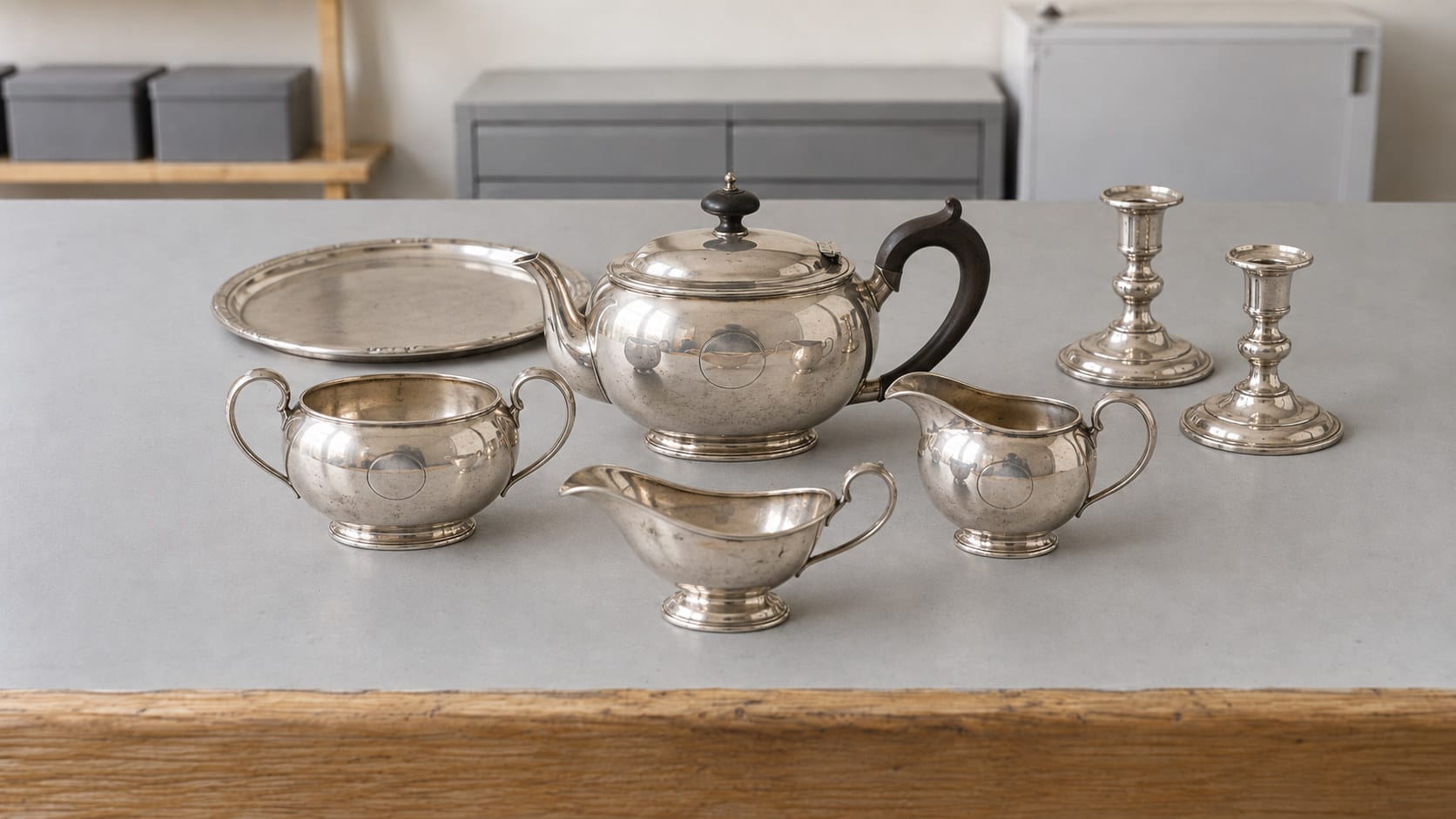
Illustration Computer-generated. Not our bench and not a customer’s lot.
- Sterling marka lion passant (thistle, lion rampant or harp on Scottish and Irish) or 925
- Often loadedmodern candlesticks, trophies, vases: heavy foot, thin body
- Rarely loadedteapots, coffee pots, trays, salvers
- Not silverwooden handles, insulators, glass liners, hinge pins
- Worth more wholematched services, and most Georgian and Regency pieces
In short
Tea sets, trays and other hollowware are bought by post, and each piece is identified on its own, because a sterling service can come with a plated tray or a replaced lid. Handles, insulators, liners and any loading in a base are left out of the weight. A set that may be worth more whole is flagged before any offer, so you can ask an auction house first.
What the word covers, and why the shapes matter
Hollowware is the trade's word for vessels and serving pieces as against cutlery: teapots, coffee pots, hot water jugs, sugar bowls, cream jugs, salvers, trays, sauce boats, tankards, goblets, candlesticks, vases and trophies. A tea set is usually three or four pieces; a full tea and coffee service adds a coffee pot and sometimes a kettle on a stand.
Most of it is thin sheet, raised, spun or seamed into shape, with walls far lighter than the size of the object suggests. That is why a large teapot can feel light, and why a small modern object that feels far too heavy may be loaded. Trays and salvers are usually heavier sheet throughout and the most straightforward pieces in this category; some have a base-metal wire inside a rolled rim, and where one is found its weight is estimated and left out.
Loaded bases: the heavy thing that is mostly pitch
Candlesticks, trophies, small vases and goblet stems, especially from the late nineteenth century onwards, are often loaded: a thin silver shell filled with pitch (a tar-like filling) or plaster and set on a weighted foot so it does not fall over. Some are stamped “loaded” or “filled” near the base. Many are not, and a pair of candlesticks that feels substantial can hold a small fraction of its weight in silver. Older cast candlesticks are the opposite: solid, heavy and often collected.
- Turn it over. A baize or felt disc glued across the underside often hides a filled base.
- A thin soldered plate closing the foot, with a small hole in it, is the same story.
- Compare the foot with the body. A heavy base under a delicate stem is the usual shape of a loaded candlestick.
- Tap the underside gently with a fingernail. A filled base sounds dead; an empty silver one rings.
- Teapots, coffee pots, trays and salvers are hardly ever loaded, so a heavy one of those is usually just heavy.
How a loaded piece is handled here
It is described as loaded on the list, with an estimate of the silver shell clearly labelled as an estimate. The filling comes out only after you have accepted, and what you are paid is the figure on your offer. Decline, and the piece goes back with its base intact. Weighted and loaded silver shows what to look for before you post.
Sterling or plate, on a curved surface
Marks on hollowware are usually struck on the underside of the base, near the rim of a salver, or on the shoulder of a pot beside the handle. Lids carry their own smaller set: a lion and a date letter, sometimes only a maker's mark. Scottish sterling carries a thistle (Edinburgh before 1975) or a lion rampant (Glasgow, and Edinburgh since 1975) instead of the lion passant, and Irish sterling a crowned harp. A set where three pieces are marked and the fourth is not is common, because the fourth was replaced at some point. The silver hallmarks guide shows what a full row should contain, and how to read a date letter explains how to check that the pieces were made together.
Telling sterling from electroplate on a tea set
| Where to look | Sterling | Electroplate |
|---|---|---|
| The marks | A standard mark (lion passant, thistle, lion rampant, crowned harp) or 925, with an assay office mark | EPNS, EP, A1, or imitation marks with no recognised office mark. A piece stamped STERLING or 800 may still be silver from abroad |
| Rims and spouts | Wears white; the metal is the same all the way through | Yellow or grey base metal shows through at the high points |
| Feet and handle joins | Same colour everywhere | Plating thin or gone where the piece has been handled for years |
A surface test can be misled where plating is thick and intact, so it settles little on its own on a polished teapot. Every piece is weighed and checked for its metal before an offer is made; the methods used depend on the piece and are listed on the offer. An acid touchstone test is used only where the other checks disagree, and only with your written consent (the terms, clause 4.2). Our guide to EPNS, A1 and Sheffield plate goes through the letters you will find on an underside.
The parts of a tea set that are not silver
- Wooden handles and finials. Fruitwood or ebony, fitted into silver sockets. The weight of the wood is left out; the sockets are counted.
- Ivory insulators. Thin discs set into a handle to keep the heat out. Ivory is restricted by law, so no piece containing it is bought; photograph such a piece instead of posting it. If one arrives anyway, it is returned whole, insulators in place. The ivory guide sets out the law.
- Steel hinge pins, lid springs and base-metal rim wires. Some trays have a wire inside a rolled rim.
- Glass liners. In sugar bowls, salt cellars, butter dishes and some jam pots. Listed on their own and returned at our cost.
- Plated pieces in an otherwise sterling set. The matching tray most of all, which is why every piece is identified on its own.
Nothing on that list is thrown away without asking, and nothing is taken off a piece before you have accepted an offer for it. Wooden handles and other parts removed after you accept can be returned to you if you want them.
Everything from the sideboard, together
Silver in a house is rarely one object. It is a tea set, a pair of candlesticks, a christening mug, two trophies from somebody's golf club, a cigarette box, a salver with an inscription and a tray that may or may not match anything. Photograph all of it first, then send it as one lot, in as many parcels as the reply suggests. Working out which pieces are sterling, which are plate and which are loaded is our job, and doing it once across the whole lot is quicker for you.
- Wrap each piece separately. Silver is soft and two pieces rubbing in a box will mark each other.
- Take the glass liners out and wrap them apart, or leave them in and pack the piece firmly. Broken glass scratches everything else in the parcel.
- Do not polish anything. Tarnish does no harm, and polish takes metal with it.
- Hollowware is bulky for its weight, so a full service usually needs more than one parcel. When you are ready to post, we arrange the postage with you and confirm the service and its cover in writing before anything is sent. Tell us in writing that the parcels belong together, and we wait until all of them arrive before making one offer (the terms, clause 3.3).
- Presentation cases and fitted boxes are not bought, and they come back to you at our cost.
Photographs often suggest the answer to the two questions that matter here: is a piece likely to be silver, and might it be worth more whole? Some things, such as loading, only show in the hand. Photograph each piece, the marks on its underside and the underside of anything with a foot, and send them on WhatsApp to 07369 296063, or ring or text that number if you do not use WhatsApp. It saves posting things that need not be posted. If there is a canteen as well, silver cutlery and canteens covers it, and probate and estate jewellery covers an estate.
Pieces that may do better at auction
A matched service may be worth more than its silver
A complete tea and coffee service by a sought-after maker, in good condition, with matching pieces and its own tray, can sell as it stands. So can Arts and Crafts pieces from named workshops and Art Deco services by leading makers. We read the marks and check completeness before anything else, and if an auction house might do better, we say so in writing before any offer so you can get its estimate first. We are a buyer, not a silver specialist, so if you think a set may be important, ask an auction house before you post.
- Matching sets by one maker, with the same date letter across the pieces, are the strongest candidates.
- Georgian and Regency hollowware usually sells above its metal value whoever made it, and pieces by sought-after makers far above.
- Dents, split seams, replaced handles and erased crests make a set more likely to be worth only its silver, though damaged Georgian silver often still sells above its metal.
- Late Victorian and Edwardian mass-produced services in plain patterns are usually worth their silver, and you are told that too.
- Inscribed presentation pieces tied to a named person, ship, regiment or institution have a history that melting destroys.
- Unusual forms, such as wine coolers, table centrepieces (epergnes) and old tea caddies, are always flagged.
What happens to a service when it arrives
- Unpacked and photographedEvery piece is recorded as it arrived, liners and handles included. Nothing is cleaned or taken off it before you accept.
- Looked at as a set firstMarks, maker, date letters and completeness are read across the whole group, because whether it may be worth more as a set comes before the pieces are treated individually.
- Identified piece by pieceEach item is checked on its own for standard, for plate and for loading, because a set is rarely uniform.
- Non-silver parts notedHandles, insulators, liners, pins and any loading are described on the list, with an estimate of a loaded shell labelled as an estimate.
- One offer for the lotA single written offer covering everything sent. Say no and everything comes back by tracked, signed-for post at our cost. Name the pieces you want back and you get a new written offer for what is left; the first offer stays open on its original terms for as long as it would have done. Offers, returns and payment explains each answer.
A service never goes on the scales as one object. In a tea set each piece can be a different metal even though they match, and weighing it as one would hide which is which. How it works covers the stages before and after this one.
What we buy, and what we leave out
We buy
- Hallmarked sterling teapots, coffee pots, hot water jugs, sugar bowls and cream jugs
- Sterling salvers, small trays (waiters) and trays, including those with wooden handles
- Sterling bowls, sauce boats, tankards, goblets, mugs and trophies
- Loaded sterling candlesticks and vases, on the silver of the shell
- Britannia standard and continental hollowware from 800 upwards, once checked; where a standard cannot be established, the offer says so
- Dented, split and incomplete sterling pieces
- Whole sideboards sent together; plated pieces are sorted out, listed and sent back free
We do not buy
- EPNS, EP, A1 and other electroplated hollowware, and Old Sheffield Plate, which is fused plate rather than electroplate; good Old Sheffield Plate can sell at auction, so ask before you discard it
- Pewter, nickel silver and Britannia metal, which is a pewter alloy and nothing to do with Britannia silver (antique pewter can still sell to collectors)
- Wooden, bone and plastic handles, finials and insulators, and any piece with ivory in it, which comes back with the ivory still attached
- Pitch, plaster and resin loading, steel pins, springs and rim wires
- Glass liners and presentation cases, which are not bought and come back to you at our cost
Stopped before anything is treated as scrap
- A complete tea or coffee service by a recognised maker, with its tray, is looked at as a set before anything else happens
- All Georgian, Regency and early Victorian hollowware is flagged as a matter of course
- Arts and Crafts and Art Deco pieces from named workshops are often sought by collectors for their design, and are flagged
- Inscribed presentation pieces tied to a person, ship, regiment or institution are flagged for their history
- Unusual forms such as wine coolers, epergnes, centrepieces and early tea caddies are always flagged
- Where a piece may do better at auction we say so in writing, and post it back free if you would rather take it there
Questions sellers ask
How do I know whether my tea set is sterling or plate?
Look for a standard mark on the underside of each piece: a lion passant on English sterling, a thistle or lion rampant on Scottish, a crowned harp on Irish, or 925 on modern pieces, with an assay office mark beside it. Plate usually carries EPNS, EP, A1 or imitation marks, and shows yellow or grey metal at worn rims and spouts. A piece stamped STERLING or 800 may be silver from abroad, so send a photograph.
Are the wooden handles and ivory insulators bought too?
No, they are not silver, but the sockets they sit in are. Wood, bone and plastic parts are left in place and their weight is left out; nothing is taken apart before you have accepted an offer. Ivory is different: it is restricted by law, so a piece containing it is not bought at all. Photograph it rather than posting it; one that arrives anyway is sent back with the ivory untouched.
My candlesticks are heavy. Why might they be worth less than they weigh?
Many twentieth-century candlesticks are loaded: a thin silver shell over a base filled with pitch or plaster, so the weight you feel is mostly the filling. Older cast candlesticks are solid and heavy, and good ones are collected, so send photographs of the base and marks first. The silver in a loaded shell is estimated before you decide, the estimate is written on your list, and your offer rests on it.
Should I send a complete Georgian tea service for melting?
Not without an auction estimate first, and we would tell you so before any offer. Georgian services usually sell above their metal value, and melting one cannot be undone.
Can a large tray go in an ordinary parcel?
Often not. A big salver is awkward as well as valuable. Tell us the size first; when you are ready to post, we arrange the postage with you and confirm the service and its cover in writing before anything is sent.
Half of what I have is plated. Is it worth sending anyway?
Send photographs first; they often show which pieces are plated, and those can stay at home. If you are not sure, send the lot: the plated pieces are named on the list and posted back at our cost.
Sources
Related
- How it works
- Send photos first
- Posting your items
- Sell silver
- What we buy
- Silver cutlery
- Probate and estates
- House clearance
- Posting safely and cover
- Offers, returns and payment
- Weighted and loaded silver: why candlesticks, trophies and knife handles weigh more than their silver
- Antique silver or scrap silver, and how to tell the difference
- Silver plate: EPNS, A1, EPBM and Sheffield plate, and what each is worth
- Ivory handles, insulators and inlay: the pieces you cannot simply sell
A canteen or a teapot nobody uses?
The marks decide most of it. Photograph the back of a spoon or the underside of a pot, and a person will say whether it looks solid or plated.
Nothing is sold until you say yes. Say no and everything comes back by tracked, signed-for post at our cost.
No WhatsApp? Call or text 07369 296063, 6am to 10pm, seven days a week.
Plate is not bought, and you will be told
Plated pieces are named on your list and sent back, never mixed into the total. Photographs often spot them before you go to the trouble of packing.