Inherited jewellery
Inherited jewellery: find what matters before anything is sold
The worry is selling the one piece that mattered, to the family or in value. Send photographs first: a person reads the marks and tells you what to hold back, and nothing leaves the house.
No obligation. Decline and it all comes back free; ask for part of it back and a fresh offer is made for the rest.
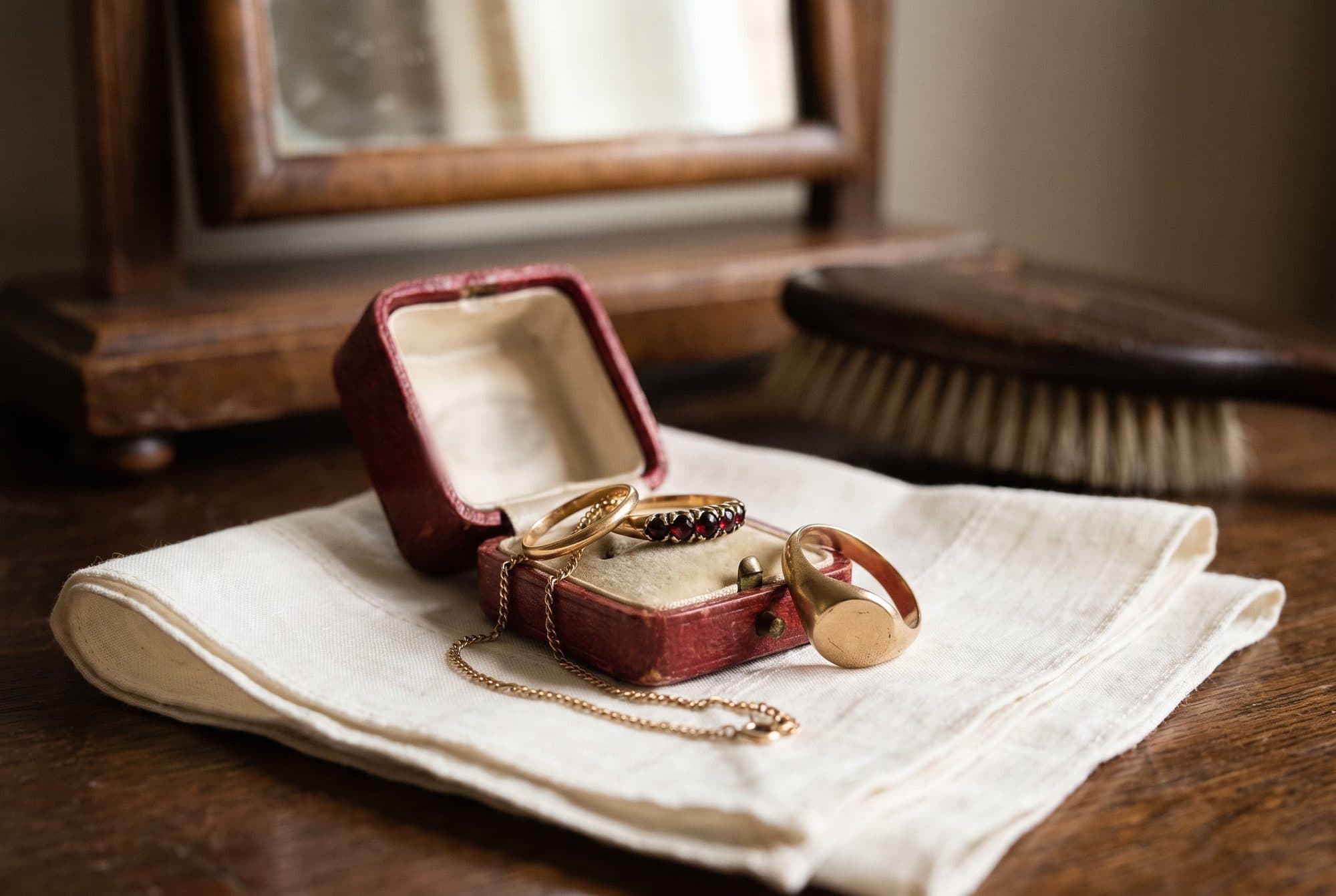
Illustration Computer-generated, not a customer’s lot.
In short
If you have been left jewellery you cannot identify, photograph it before you decide anything. The marks show whether a piece is gold, silver, plated or filled, and a clear photograph of them is usually enough for someone to tell you which. Nothing has to be sold to find out. Dated coins, hallmarked antique silver, signed pieces and watches that still run are often worth more whole than as metal, so hold those back and have them looked at first.
Nothing here needs deciding today
There is no deadline on any of this. Finding out what you have costs nothing and commits you to nothing, and if you ask for more time at any stage you get it, without giving a reason (clause 10.2). Leaving the box in the drawer for another year is a perfectly good answer.
You are allowed to keep it, and you are allowed to sell it
People who have been left jewellery often reach one of two guilty conclusions: that selling any of it would be a betrayal, or that keeping a drawer of things nobody wears is hoarding. Neither is true. The choice was left to you along with the box.
The outcome worth avoiding is a third one, and it happens often. The box sits in a wardrobe for fifteen years, is cleared in a hurry by someone who never knew the person, and the two pieces that mattered go out with the rest. An hour spent finding out what is there prevents that, whatever you then decide.
Working out what you actually have
Start with the marks. British gold and silver has been independently tested and hallmarked for centuries, so most of what you are holding will say what it is if you can get light on it. Hold a phone camera close, with a lamp to one side rather than behind you; it reads a hallmark better than most eyes do.
- Gold, marked375, 585, 750, 916
- Silver, marked800, 925, 958
- Not silverEPNS, A1, plated
- Not solid goldGF, RG, rolled
A three-figure number is a fineness: how many parts in a thousand are the precious metal, so 375 is 9 carat and 750 is 18 carat. Beside it there is usually a small punched symbol for the assay office that tested it, and often a letter for the year. Reading UK hallmarks takes each mark in turn.
EPNS, A1, GF, RG and the words rolled gold all mean a thin layer of precious metal over a base metal, and so do fractions such as 1/20 12ct. We do not buy silver plate, or gold plate and gold-filled pieces with nothing recoverable in them (clause 11.1). Plated, rolled, filled and vermeil shows how to tell them from solid metal.
An unmarked piece is not automatically worthless. Small items can legally be sold unhallmarked, foreign gold is often marked in a system nobody here recognises, and sixty years of wear can take a mark off a wedding ring. Unmarked means untested, not fake. If you cannot get a legible picture, send the photograph anyway and say which piece it came from.
If the box is a tangle, a box of jewellery you cannot identify sorts it into six piles using four checks that need only a magnet and daylight.
The pieces that are worth more whole than melted
This is the fear most people in your position have: sending off a box and learning afterwards that something in it should never have been treated as metal. Six signals catch most of it, and you can check each one at the kitchen table.
- A name on itInside a band, on the pin of a brooch, on the clasp of a necklace, under the foot of a candlestick. A maker whose work is collected changes what a piece is: it stops being an amount of gold and becomes a thing with a market of its own. Photograph the mark even if you cannot read it.
- A date on a coinSovereigns have been struck for more than two centuries, at the Royal Mint and at branch mints around the world. The year and the small mint letter decide whether a coin is ordinary or scarce. Do not clean it. See what to check on a sovereign.
- A watch that still runsWind it. A mechanical watch that ticks, or a quartz one that starts with a new battery, is a watch rather than a gold case with a movement inside. The two are assessed differently. See gold and pocket watches.
- A set that is still completeSix of something is worth a look; twelve in a fitted box with the serving pieces is a different proposition again. Do not split a canteen to make it easier to post, and do not polish it. See antique silver or scrap.
- Stones you cannot judgeA stone in an old setting may be glass, a garnet, or something that wants a gemmologist. Stones are not paid for as metal, and no stone is taken out of its setting before you accept an offer (clause 4.4). A good one is easy to undervalue unless somebody says so.
- Something that is simply oddA medal on a ribbon, an enamelled badge, a mourning brooch with hair in it, a signet with a crest nobody recognises. A named medal group should never be sold as scrap, and the medals guide explains why. Anything that might be ivory, such as a carved brooch or a knife handle, should be photographed and not posted: the ivory guide sets out the law.
If any of those apply, that piece wants a second opinion before anyone treats it as metal. What to have looked at before you sell goes through each kind of object. An auction house, a specialist dealer or a valuer will look at a signed brooch differently from a metal buyer.
The ordinary pieces, and why that is fine
Most of a normal box is ordinary, and there is no shame in that. A snapped 9ct curb chain, one earring whose partner went down a sink in 1987, a bent bangle, a wedding ring worn thin. None of it has a market as jewellery, and all of it is gold. The same goes for dented napkin rings and cutlery in a pattern nobody collects.
Two things in the ordinary pile are worth pulling out anyway. Broken clasps, spring rings and jump rings are still gold, and people throw them away as debris. Dental gold, which nobody enjoys handling, is precious metal too, though dental alloys vary far more than jewellery does. See scrap and broken gold jewellery and dental gold.
What to keep
Nobody else can tell you what to keep. Six rules of thumb help while you decide.
- Keep the piece you can picture being worn. If a face comes with it, that is not sentiment clouding your judgement; it is the answer.
- Keep anything you are undecided about. Keeping costs nothing and the choice is still open next year; a sale cannot be taken back.
- Photograph everything before any of it leaves the house, including what you sell. Once a piece has gone, the photograph is what the family keeps.
- Do not keep something only because you cannot face deciding. That is how a box ends up being dealt with by a stranger.
- If more than one person has a claim, settle it before anything is posted. Dividing jewellery between beneficiaries sets out how.
- Do not clean, polish or untangle anything first. Polish takes value off old silver and a forced knot breaks a chain; see cleaning before you sell.
What we undertake, in the order it happens
Seven undertakings, each with the clause of the terms that holds us to it where there is one. This is what each means for a box of somebody else's jewellery.
- Ask before you postPhotographs first, from your own table, with nothing leaving the house. A person reads the marks and gives you a rough idea of what the box is, free and with no obligation. Asking is how you find out whether posting is worth doing at all.
- Everything is itemisedWhen the parcel is opened, every piece is listed and described, including anything we will not buy (clause 4.4). The list comes with your offer, so you can say “that is not my grandmother's ring” or “where is the brooch” before you are asked to decide anything.
- One written offer for the lotNot a figure read out on the telephone while you hunt for a pen. One written offer for the lot, with the item list on it, to read when the house is quiet (clause 5.1).
- Nothing is sold until you say yesYou accept by pressing the button on your offer or by telling us in writing (clause 6.1). Silence is never acceptance, nothing expires into a sale, and your items stay as they arrived while you think (clause 6.2).
- Free tracked returnDecline the whole lot and it comes back tracked and signed for, at our cost. Ask for one piece back and a fresh written offer is made for the rest, while the first stays open (clause 6.3).
- Worth more whole? We say soA signed piece, a sovereign with a scarce date, a watch that runs, antique silver: you are told before anything is priced as metal. For an inherited lot we will post the whole box back at our cost while you get another opinion, with no obligation to send it again (clause 10.3).
- A person handles itThe same person opens the parcel, writes the list and the offer, and answers when you ask why a piece was described as it was. Not a queue, and not somebody who has never seen the items.
If you decide to sell part of it
Selling is one option among several. An auction house suits a collectable piece, a specialist dealer suits a named watch, and a jeweller can reset a stone you want to keep. What we are for is the rest of the box: the mixed, broken, unfashionable and unidentified, dealt with in one go.
The route is the same for everyone. Send photographs and get a rough idea back; ask for a prepaid tracked label if you want to go further; post it when it suits you. It is booked in, itemised, weighed and tested, and one written offer comes back for the lot. How it works follows a parcel all the way through.
Two guides are worth reading before you post anything to anyone. How to check a postal gold buyer lists what to look up about any buyer, this one included. If there are coins or a quantity of gold, selling inherited gold and coins: the tax position sets it out in plain terms.
Questions people ask about an inherited box
Is it wrong to sell something I was left?
No. A drawer of jewellery nobody wears is not a memorial, and the person who left it to you left you the choice as well. Keep what you would look for in ten years, and be honest with yourself about the rest. If you are unsure about a particular piece, keep it: a piece you still own can be sold later, and a piece you have sold cannot be unsold.
Can you tell from photographs whether any of it is real gold?
Often, yes, and that is what the photographs are for. A clear picture of a hallmark, and of the piece beside something for scale, usually lets a person say what the marks mean. It also shows whether a piece looks plated rather than solid, and whether it should see a specialist first. The reply is an estimate, not a valuation or an offer, and it binds neither of us (clause 2.1).
Do I need probate before I can sell something I was left?
Once the executor has passed a piece to you, it is yours to decide about. While the estate is still being administered, its possessions are the executor's to deal with, and selling jewellery before probate is granted describes the usual order in England and Wales. You may be asked to show that a piece is yours to sell; for an inherited piece that can mean probate papers (clause 9.1).
Can I send some of it and keep the rest?
Yes. Send the pieces you have decided about and keep the ones you have not. One thing to know first: a lot is priced as a lot. A second parcel sent on a later day is treated as a separate lot with its own offer, unless you ask us in writing to hold the first until the second arrives (clause 3.3).
What if I change my mind after I have posted it?
Tell us, and everything comes back at our cost. You can do that at any point before you accept, including before the offer is made (clause 6.4). Until then nothing is melted, cut, polished or taken apart. Offers, returns and payment sets out the rest.
There are several of us in the family. Does that change anything?
It changes who has to agree, not how the work is done. The offer comes with a described list of every piece, so a family can decide from the same list rather than from memory. A piece somebody wants can be asked back before the rest is settled (clause 6.3). If you are the executor rather than a beneficiary, the page for executors is written for you.
Will you tell me if something is worth more than its metal?
Yes, and before it is priced as metal rather than after (clause 4.4). Coins, antique silver, signed pieces, working watches and anything with a notable stone are flagged, with a note that the piece may do better at an auction house or with a specialist dealer. We would rather buy the rest of the box and tell you the truth about one piece in it.
Not sure what you have? Start with photographs.
Photograph the lot: the tangled chains, the single earrings, the canteen nobody uses, the bits you cannot identify. Send it over and you get a rough idea back, with no pressure of any kind. Post it afterwards if you want to, or do not.
Nothing is sold until you say yes. Decline and it all comes back by tracked post, free; ask for part of it back and a fresh offer is made for the rest.
If a piece is worth more than its metal
A signed brooch, a date-run sovereign, a watch that still runs, a piece of early silver: anything that looks worth more whole is flagged to you before it is treated as metal, and you can take it back at that point.